# Adapting in Trauma: A Psychiatric Seminar on Dissociative Identity Disorder
## Learning Objectives
- Apply DSM-5-TR criteria to diagnose Dissociative Identity Disorder without reifying self-states.
- Distinguish DID from psychotic, bipolar, personality, trauma-related, neurologic, substance-related, and culturally sanctioned presentations.
- Interpret neurobiological findings while recognizing their methodological limitations and lack of diagnostic specificity.
- Formulate DID through a developmental, trauma-informed, and culturally responsive framework.
- Implement phase-oriented treatment with explicit safety, stabilization, trauma-processing, and rehabilitation criteria.
- Prescribe medication only for defined comorbid targets using appropriate dosing and monitoring.
- Measure recovery through safety, memory continuity, agency, relationships, and function rather than mandatory fusion.
---
## Introduction to Dissociative Identity Disorder
 **Duration:** 10 minutes
**Content Tier:** MUST ACT
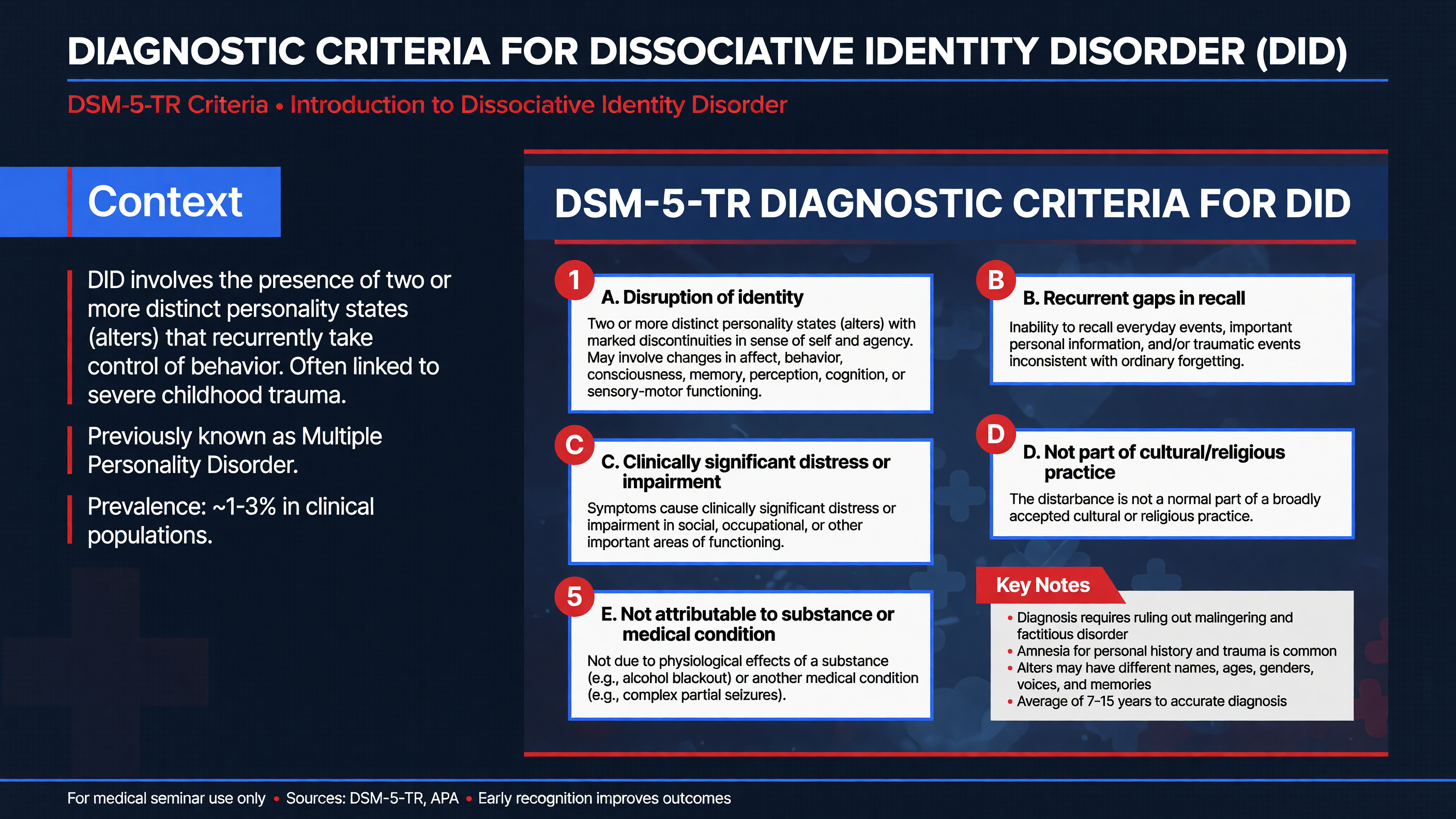
Dissociative Identity Disorder (DID; DSM-5-TR 300.14/F44.81) is a disorder of disrupted integration within one person. It is not the presence of several biologically or legally separate people, and “multiple personality disorder” is obsolete terminology. The central phenomenon is a recurrent discontinuity in the person’s sense of self and agency, accompanied by state-linked changes in affect, behavior, consciousness, memory, perception, cognition, or sensory-motor functioning. Clinicians may observe these changes, but DSM-5 permits diagnosis when the patient reliably reports them; dramatic switching in the interview is not required. DSM-5 also explicitly recognizes possession-form presentations and amnesia for everyday events, not only trauma ([PMID: 23394228](https://pubmed.ncbi.nlm.nih.gov/23394228/)).
Diagnosis requires two linked phenomena. First, there must be two or more identity states, experienced as marked discontinuity rather than ordinary changes in mood, role, or preference. Second, the patient must have recurrent memory gaps beyond ordinary forgetting—for example, discovering completed work, messages, purchases, travel, injuries, or conversations without recollection; losing access to important autobiographical information; or being unable to account for practiced skills at particular times. The symptoms must cause clinically significant distress or impairment and must not be better explained by intoxication, alcohol blackout, medication effects, focal impaired-awareness seizures, another medical condition, culturally sanctioned possession, or—in children—fantasy play.
**Framework:** Think in dimensions: identity discontinuity, amnesia, depersonalization, derealization, intrusions, and altered agency. The diagnosis emerges from their longitudinal pattern, not from one unusual behavior or the number of named self-states.
DID is frequently covert. Patients may present with depression, PTSD symptoms, panic, nightmares, self-injury, substance use, eating pathology, somatic complaints, “voices,” memory problems, or treatment-resistant personality symptoms. Many experience thoughts, emotions, impulses, speech, or movements as originating from “not me.” Others report being an observer while their body acts. These experiences can be terrifying without implying delusional conviction. Neutral terms such as *self-state*, *identity state*, or the patient’s preferred language validate experience without prematurely asserting a mechanism.
Community estimates cluster around 1%, although results vary substantially by sampling, culture, instruments, and attrition. One community study found a 1.5% past-year prevalence and clinically significant functional impairment ([PMID: 16337235](https://pubmed.ncbi.nlm.nih.gov/16337235/)); this should not be treated as a universal rate. Incidence, untreated course, and sex distribution remain incompletely characterized.
**MUST ACT:** At first contact, prioritize suicide risk, nonsuicidal self-injury, accidental harm during amnestic periods, access to lethal means, medication duplication, intoxication or withdrawal, ongoing victimization, and the safety of dependent children. Ask whether “any part of you” has thoughts, plans, hidden means, or behaviors that other parts may not remember. Do not attempt to provoke a switch to conduct the assessment.
**Teaching Point:** A patient can meet criteria without displaying theatrical state changes. Conversely, visibly different mannerisms, names, accents, or handwriting do not establish DID without qualifying amnesia, impairment, exclusions, and longitudinal consistency.
**Audience Poll:** Which finding carries the greatest diagnostic weight: voice hearing, a reported trauma history, abrupt affective shifts, or recurrent identity discontinuity accompanied by amnesia beyond ordinary forgetting?
---
## Neurobiological Framework of Dissociation
**Duration:** 10 minutes
**Content Tier:** MUST ACT
Dissociative Identity Disorder (DID; DSM-5-TR 300.14/F44.81) is a disorder of disrupted integration within one person. It is not the presence of several biologically or legally separate people, and “multiple personality disorder” is obsolete terminology. The central phenomenon is a recurrent discontinuity in the person’s sense of self and agency, accompanied by state-linked changes in affect, behavior, consciousness, memory, perception, cognition, or sensory-motor functioning. Clinicians may observe these changes, but DSM-5 permits diagnosis when the patient reliably reports them; dramatic switching in the interview is not required. DSM-5 also explicitly recognizes possession-form presentations and amnesia for everyday events, not only trauma ([PMID: 23394228](https://pubmed.ncbi.nlm.nih.gov/23394228/)).
Diagnosis requires two linked phenomena. First, there must be two or more identity states, experienced as marked discontinuity rather than ordinary changes in mood, role, or preference. Second, the patient must have recurrent memory gaps beyond ordinary forgetting—for example, discovering completed work, messages, purchases, travel, injuries, or conversations without recollection; losing access to important autobiographical information; or being unable to account for practiced skills at particular times. The symptoms must cause clinically significant distress or impairment and must not be better explained by intoxication, alcohol blackout, medication effects, focal impaired-awareness seizures, another medical condition, culturally sanctioned possession, or—in children—fantasy play.
**Framework:** Think in dimensions: identity discontinuity, amnesia, depersonalization, derealization, intrusions, and altered agency. The diagnosis emerges from their longitudinal pattern, not from one unusual behavior or the number of named self-states.
DID is frequently covert. Patients may present with depression, PTSD symptoms, panic, nightmares, self-injury, substance use, eating pathology, somatic complaints, “voices,” memory problems, or treatment-resistant personality symptoms. Many experience thoughts, emotions, impulses, speech, or movements as originating from “not me.” Others report being an observer while their body acts. These experiences can be terrifying without implying delusional conviction. Neutral terms such as *self-state*, *identity state*, or the patient’s preferred language validate experience without prematurely asserting a mechanism.
Community estimates cluster around 1%, although results vary substantially by sampling, culture, instruments, and attrition. One community study found a 1.5% past-year prevalence and clinically significant functional impairment ([PMID: 16337235](https://pubmed.ncbi.nlm.nih.gov/16337235/)); this should not be treated as a universal rate. Incidence, untreated course, and sex distribution remain incompletely characterized.
**MUST ACT:** At first contact, prioritize suicide risk, nonsuicidal self-injury, accidental harm during amnestic periods, access to lethal means, medication duplication, intoxication or withdrawal, ongoing victimization, and the safety of dependent children. Ask whether “any part of you” has thoughts, plans, hidden means, or behaviors that other parts may not remember. Do not attempt to provoke a switch to conduct the assessment.
**Teaching Point:** A patient can meet criteria without displaying theatrical state changes. Conversely, visibly different mannerisms, names, accents, or handwriting do not establish DID without qualifying amnesia, impairment, exclusions, and longitudinal consistency.
**Audience Poll:** Which finding carries the greatest diagnostic weight: voice hearing, a reported trauma history, abrupt affective shifts, or recurrent identity discontinuity accompanied by amnesia beyond ordinary forgetting?
---
## Neurobiological Framework of Dissociation
 **Duration:** 10 minutes
**Content Tier:** Teaching Point
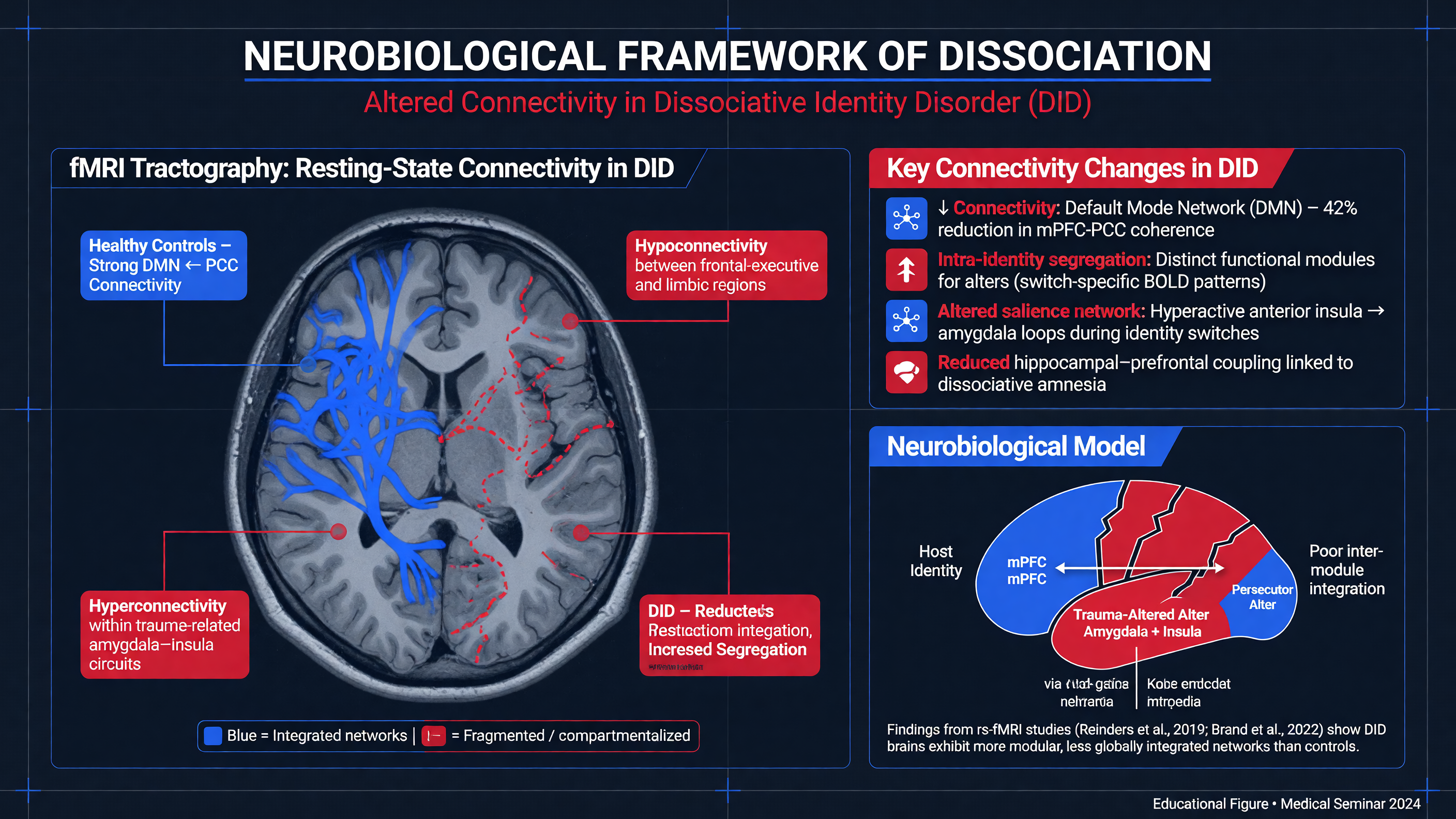
Dissociation can be conceptualized as altered coordination among systems responsible for threat detection, interoception, autobiographical memory, executive control, agency, and self-referential processing. Detachment phenomena—depersonalization, derealization, emotional numbing, altered pain—reduce the felt immediacy of experience. Compartmentalization phenomena restrict voluntary access to memories, skills, affects, or actions. DID combines these dimensions with recurrent identity discontinuity. This is a dynamic network formulation, not evidence that the brain contains anatomically partitioned personalities.
Under threat, some patients enter hyperaroused states characterized by autonomic activation, intrusive sensory-affective material, defensive action, and reduced prefrontal regulation. Others enter detached or hypoaroused states with emotional suppression, narrowed interoception, analgesia, and increased top-down control. These states can alternate within the same patient. The relevant circuitry includes the amygdala and insula for salience and threat; hippocampal and parahippocampal systems for contextual memory; medial prefrontal and default-mode networks for autobiographical self-processing; and anterior cingulate, frontoparietal, and executive networks for conflict monitoring and regulation.
Small PET studies using trauma-script provocation have reported different regional blood-flow and autonomic patterns in relatively detached versus trauma-engaged identity states. One study found greater prefrontal, cingulate, posterior-association, and parahippocampal recruitment in a more detached state, whereas a hyperaroused state more strongly engaged amygdala, insula, and caudate circuitry ([PMID: 24976633](https://pubmed.ncbi.nlm.nih.gov/24976633/)). Such within-person findings support state-dependent regulation, but they do not prove that the states are independent persons or establish the cause of DID.
**Teaching Point:** “Prefrontal–amygdala disconnection” is too simple. Studies implicate distributed salience, executive, default-mode, medial-temporal, sensorimotor, and autonomic systems, with direction and magnitude varying by task and clinical state.
A 2022 systematic review found only 13 eligible functional-neuroimaging studies, including 51 participants with DID. Prefrontal, anterior cingulate, insular, parietal, temporal, caudate, and other subcortical findings recurred, but small samples, medication exposure, PTSD comorbidity, reused cohorts, and heterogeneous paradigms precluded a diagnostic signature ([PMID: 36143190](https://pubmed.ncbi.nlm.nih.gov/36143190/)). Structural studies have reported smaller hippocampal volumes in DID-plus-PTSD samples. A meta-analysis supported smaller bilateral hippocampi relative to healthy controls but included only three studies and found no consistent amygdala difference ([PMID: 33433297](https://pubmed.ncbi.nlm.nih.gov/33433297/)). Trauma exposure, depression, chronic stress, and PTSD can also affect these structures.
Memory findings require equal nuance. Patients may experience profound inter-state inaccessibility while experimental tasks demonstrate partial implicit or explicit transfer. A 2024 systematic review and meta-analysis found evidence both for memory transfer and for amnesia-like patterns, with small, heterogeneous samples ([PMID: 39541721](https://pubmed.ncbi.nlm.nih.gov/39541721/)). Clinical amnesia therefore should not be equated with erased information or an impermeable neural wall. State-dependent retrieval, avoidance, metacognitive beliefs, attentional control, and reduced ownership of accessible memories may all contribute.
**Nuance:** Biological correlates make the symptoms neither more nor less legitimate. Neuroimaging demonstrates associations; it does not distinguish cause from consequence or DID from complex PTSD, BPD, depression, chronic stress, or medication effects.
**MUST ACT:** Do not order MRI, PET, EEG, autonomic testing, or neuropsychological testing merely to “confirm” DID. Use neurologic investigations when spell phenomenology, focal findings, cognitive decline, injury, or another medical feature creates an independent indication.
**Audience Poll:** What is the most accurate interpretation of a state-dependent imaging difference: diagnostic proof, evidence of separate brains, a correlate of changing regulation, or confirmation of a particular trauma memory?
---
## Common Misdiagnoses and Diagnostic Challenges
**Duration:** 10 minutes
**Content Tier:** Teaching Point
Dissociation can be conceptualized as altered coordination among systems responsible for threat detection, interoception, autobiographical memory, executive control, agency, and self-referential processing. Detachment phenomena—depersonalization, derealization, emotional numbing, altered pain—reduce the felt immediacy of experience. Compartmentalization phenomena restrict voluntary access to memories, skills, affects, or actions. DID combines these dimensions with recurrent identity discontinuity. This is a dynamic network formulation, not evidence that the brain contains anatomically partitioned personalities.
Under threat, some patients enter hyperaroused states characterized by autonomic activation, intrusive sensory-affective material, defensive action, and reduced prefrontal regulation. Others enter detached or hypoaroused states with emotional suppression, narrowed interoception, analgesia, and increased top-down control. These states can alternate within the same patient. The relevant circuitry includes the amygdala and insula for salience and threat; hippocampal and parahippocampal systems for contextual memory; medial prefrontal and default-mode networks for autobiographical self-processing; and anterior cingulate, frontoparietal, and executive networks for conflict monitoring and regulation.
Small PET studies using trauma-script provocation have reported different regional blood-flow and autonomic patterns in relatively detached versus trauma-engaged identity states. One study found greater prefrontal, cingulate, posterior-association, and parahippocampal recruitment in a more detached state, whereas a hyperaroused state more strongly engaged amygdala, insula, and caudate circuitry ([PMID: 24976633](https://pubmed.ncbi.nlm.nih.gov/24976633/)). Such within-person findings support state-dependent regulation, but they do not prove that the states are independent persons or establish the cause of DID.
**Teaching Point:** “Prefrontal–amygdala disconnection” is too simple. Studies implicate distributed salience, executive, default-mode, medial-temporal, sensorimotor, and autonomic systems, with direction and magnitude varying by task and clinical state.
A 2022 systematic review found only 13 eligible functional-neuroimaging studies, including 51 participants with DID. Prefrontal, anterior cingulate, insular, parietal, temporal, caudate, and other subcortical findings recurred, but small samples, medication exposure, PTSD comorbidity, reused cohorts, and heterogeneous paradigms precluded a diagnostic signature ([PMID: 36143190](https://pubmed.ncbi.nlm.nih.gov/36143190/)). Structural studies have reported smaller hippocampal volumes in DID-plus-PTSD samples. A meta-analysis supported smaller bilateral hippocampi relative to healthy controls but included only three studies and found no consistent amygdala difference ([PMID: 33433297](https://pubmed.ncbi.nlm.nih.gov/33433297/)). Trauma exposure, depression, chronic stress, and PTSD can also affect these structures.
Memory findings require equal nuance. Patients may experience profound inter-state inaccessibility while experimental tasks demonstrate partial implicit or explicit transfer. A 2024 systematic review and meta-analysis found evidence both for memory transfer and for amnesia-like patterns, with small, heterogeneous samples ([PMID: 39541721](https://pubmed.ncbi.nlm.nih.gov/39541721/)). Clinical amnesia therefore should not be equated with erased information or an impermeable neural wall. State-dependent retrieval, avoidance, metacognitive beliefs, attentional control, and reduced ownership of accessible memories may all contribute.
**Nuance:** Biological correlates make the symptoms neither more nor less legitimate. Neuroimaging demonstrates associations; it does not distinguish cause from consequence or DID from complex PTSD, BPD, depression, chronic stress, or medication effects.
**MUST ACT:** Do not order MRI, PET, EEG, autonomic testing, or neuropsychological testing merely to “confirm” DID. Use neurologic investigations when spell phenomenology, focal findings, cognitive decline, injury, or another medical feature creates an independent indication.
**Audience Poll:** What is the most accurate interpretation of a state-dependent imaging difference: diagnostic proof, evidence of separate brains, a correlate of changing regulation, or confirmation of a particular trauma memory?
---
## Common Misdiagnoses and Diagnostic Challenges
 **Duration:** 10 minutes
**Content Tier:** MUST ACT
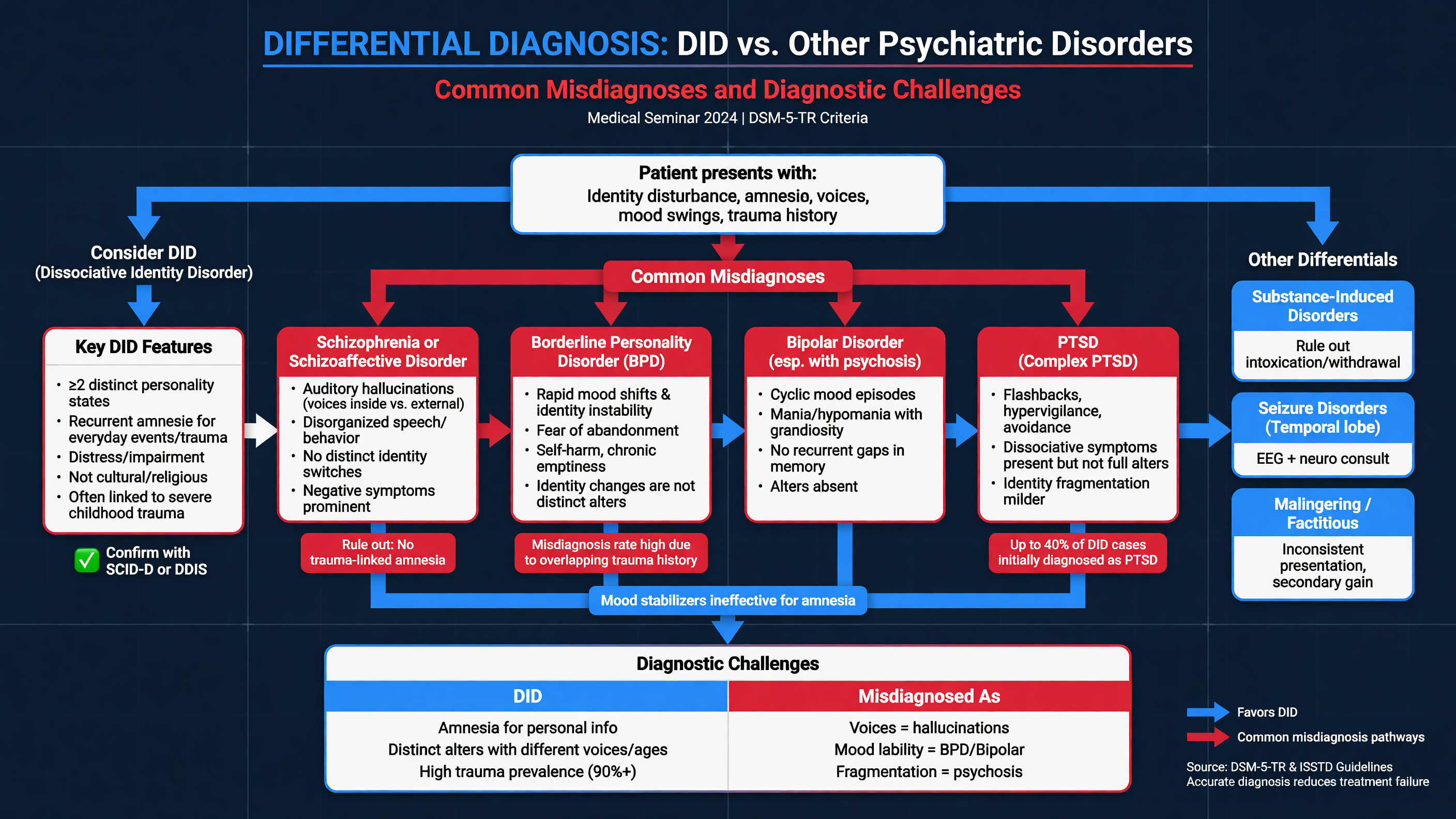
DID is both missed and over-attributed because dissociation is transdiagnostic. A defensible assessment begins with phenomenology rather than labels: “Do you find evidence that you did something you cannot remember?” “Does your speech or behavior ever feel outside your usual control?” “How long do these episodes last?” “What do observers see?” Establish onset, course, triggers, sleep, substances, medications, neurologic symptoms, head injury, trauma-related symptoms, mood episodes, psychosis, and functional consequences. Review records and obtain collateral with consent. Reassessment after sleep restoration or sobriety may be more informative than a single acute interview.
The Dissociative Experiences Scale-II is a screening instrument, not a diagnostic test. High scores occur in PTSD, BPD, functional neurological disorder, substance use, schizophrenia-spectrum illness, and other conditions ([PMID: 28946763](https://pubmed.ncbi.nlm.nih.gov/28946763/)). A positive screen should lead to structured assessment, not automatic diagnosis. The SCID-D evaluates amnesia, depersonalization, derealization, identity confusion, and identity alteration; initial work demonstrated useful reliability and discriminant validity ([PMID: 2293792](https://pubmed.ncbi.nlm.nih.gov/2293792/)). The Multidimensional Inventory of Dissociation is a detailed self-report adjunct. Neither replaces clinical judgment, exclusions, collateral, or longitudinal observation.
**Framework:** Diagnose from converging evidence: qualifying current symptoms, temporal pattern, functional impact, structured interviewing, collateral information, exclusion of mimics, and consistency over time.
BPD causes unstable self-image, values, relationships, and affect, with transient stress-related dissociation. DID more specifically requires recurrent discontinuity in agency or self-state plus amnesia beyond ordinary forgetting. Self-injury, trauma exposure, abandonment sensitivity, and internal conflict occur in both; comorbidity is possible. Do not force an either/or diagnosis or reinterpret every BPD “mode” as a dissociative identity.
PTSD can include amnesia, flashbacks, depersonalization, and derealization. Complex PTSD adds affect dysregulation, negative self-concept, and relational disturbance. DID should be added only when identity discontinuity and qualifying amnesia are independently present. Depersonalization/derealization disorder produces persistent detachment with intact reality testing but does not ordinarily cause recurrent executive-control shifts or DID-level memory gaps. Dissociative amnesia lacks DID’s recurrent identity discontinuity; OSDD or ICD-11 partial DID may better fit clinically significant but incomplete presentations.
Voice hearing occurs in DID and psychotic disorders. Internal versus external location is not decisive. Sustained formal thought disorder, negative symptoms, fixed delusions, progressive psychotic deterioration, and psychosis independent of state shifts favor a primary schizophrenia-spectrum disorder. A SCID-D study demonstrated different dissociative-symptom profiles in DID and schizophrenia-spectrum patients ([PMID: 8083678](https://pubmed.ncbi.nlm.nih.gov/8083678/)), but genuine comorbidity remains possible. Antipsychotic nonresponse does not prove that voices are dissociative.
Bipolar disorder requires syndromal episodes with characteristic duration and changes in mood, energy, activity, sleep need, cognition, and behavior. Minute-to-hour, cue-linked shifts with amnesia are not “rapid cycling.” ADHD may explain forgetfulness and inconsistent task completion but not recurrent autobiographical gaps with identity discontinuity.
**Decision Point:** Stereotyped brief spells, automatisms, aura, post-event confusion, injury, incontinence, focal findings, new late-life onset, or cognitive decline should prompt neurologic evaluation. Consider focal epilepsy, syncope, parasomnia, narcolepsy, TBI, delirium, neurocognitive disorder, migraine, or functional seizures. Test for intoxicants, withdrawal, glucose disturbance, pregnancy, endocrine or metabolic disease only as clinically indicated; no universal “DID laboratory panel” exists.
Culturally sanctioned trance or possession is not pathological when voluntary, bounded, accepted, and nonimpairing. Use a cultural formulation before diagnosing involuntary possession-form DID. In forensic or incentive-laden settings, assess factitious behavior or malingering through motive, records, longitudinal consistency, symptom-validity methods, and collateral evidence. Dramatic presentation, online terminology, or social-media familiarity is not proof of fabrication.
**MUST ACT:** Avoid leading questions, aggressive identity “mapping,” requests to demonstrate switching, or statements that hidden abuse must explain symptoms. Document patient report, collateral report, objective evidence, and clinician inference separately.
**Nuance:** A fragmented or changing trauma narrative is nonspecific. High arousal, PTSD, BPD, intoxication, TBI, ordinary reconstruction, and suggestive interviewing can all affect recall.
**Audience Poll:** When a patient with “voices” retains reality testing and reports missing time, what additional finding would most strongly shift your formulation toward primary psychosis?
---
## Childhood Trauma and DID Development
**Duration:** 10 minutes
**Content Tier:** MUST ACT
DID is both missed and over-attributed because dissociation is transdiagnostic. A defensible assessment begins with phenomenology rather than labels: “Do you find evidence that you did something you cannot remember?” “Does your speech or behavior ever feel outside your usual control?” “How long do these episodes last?” “What do observers see?” Establish onset, course, triggers, sleep, substances, medications, neurologic symptoms, head injury, trauma-related symptoms, mood episodes, psychosis, and functional consequences. Review records and obtain collateral with consent. Reassessment after sleep restoration or sobriety may be more informative than a single acute interview.
The Dissociative Experiences Scale-II is a screening instrument, not a diagnostic test. High scores occur in PTSD, BPD, functional neurological disorder, substance use, schizophrenia-spectrum illness, and other conditions ([PMID: 28946763](https://pubmed.ncbi.nlm.nih.gov/28946763/)). A positive screen should lead to structured assessment, not automatic diagnosis. The SCID-D evaluates amnesia, depersonalization, derealization, identity confusion, and identity alteration; initial work demonstrated useful reliability and discriminant validity ([PMID: 2293792](https://pubmed.ncbi.nlm.nih.gov/2293792/)). The Multidimensional Inventory of Dissociation is a detailed self-report adjunct. Neither replaces clinical judgment, exclusions, collateral, or longitudinal observation.
**Framework:** Diagnose from converging evidence: qualifying current symptoms, temporal pattern, functional impact, structured interviewing, collateral information, exclusion of mimics, and consistency over time.
BPD causes unstable self-image, values, relationships, and affect, with transient stress-related dissociation. DID more specifically requires recurrent discontinuity in agency or self-state plus amnesia beyond ordinary forgetting. Self-injury, trauma exposure, abandonment sensitivity, and internal conflict occur in both; comorbidity is possible. Do not force an either/or diagnosis or reinterpret every BPD “mode” as a dissociative identity.
PTSD can include amnesia, flashbacks, depersonalization, and derealization. Complex PTSD adds affect dysregulation, negative self-concept, and relational disturbance. DID should be added only when identity discontinuity and qualifying amnesia are independently present. Depersonalization/derealization disorder produces persistent detachment with intact reality testing but does not ordinarily cause recurrent executive-control shifts or DID-level memory gaps. Dissociative amnesia lacks DID’s recurrent identity discontinuity; OSDD or ICD-11 partial DID may better fit clinically significant but incomplete presentations.
Voice hearing occurs in DID and psychotic disorders. Internal versus external location is not decisive. Sustained formal thought disorder, negative symptoms, fixed delusions, progressive psychotic deterioration, and psychosis independent of state shifts favor a primary schizophrenia-spectrum disorder. A SCID-D study demonstrated different dissociative-symptom profiles in DID and schizophrenia-spectrum patients ([PMID: 8083678](https://pubmed.ncbi.nlm.nih.gov/8083678/)), but genuine comorbidity remains possible. Antipsychotic nonresponse does not prove that voices are dissociative.
Bipolar disorder requires syndromal episodes with characteristic duration and changes in mood, energy, activity, sleep need, cognition, and behavior. Minute-to-hour, cue-linked shifts with amnesia are not “rapid cycling.” ADHD may explain forgetfulness and inconsistent task completion but not recurrent autobiographical gaps with identity discontinuity.
**Decision Point:** Stereotyped brief spells, automatisms, aura, post-event confusion, injury, incontinence, focal findings, new late-life onset, or cognitive decline should prompt neurologic evaluation. Consider focal epilepsy, syncope, parasomnia, narcolepsy, TBI, delirium, neurocognitive disorder, migraine, or functional seizures. Test for intoxicants, withdrawal, glucose disturbance, pregnancy, endocrine or metabolic disease only as clinically indicated; no universal “DID laboratory panel” exists.
Culturally sanctioned trance or possession is not pathological when voluntary, bounded, accepted, and nonimpairing. Use a cultural formulation before diagnosing involuntary possession-form DID. In forensic or incentive-laden settings, assess factitious behavior or malingering through motive, records, longitudinal consistency, symptom-validity methods, and collateral evidence. Dramatic presentation, online terminology, or social-media familiarity is not proof of fabrication.
**MUST ACT:** Avoid leading questions, aggressive identity “mapping,” requests to demonstrate switching, or statements that hidden abuse must explain symptoms. Document patient report, collateral report, objective evidence, and clinician inference separately.
**Nuance:** A fragmented or changing trauma narrative is nonspecific. High arousal, PTSD, BPD, intoxication, TBI, ordinary reconstruction, and suggestive interviewing can all affect recall.
**Audience Poll:** When a patient with “voices” retains reality testing and reports missing time, what additional finding would most strongly shift your formulation toward primary psychosis?
---
## Childhood Trauma and DID Development
 **Duration:** 10 minutes
**Content Tier:** Nuance
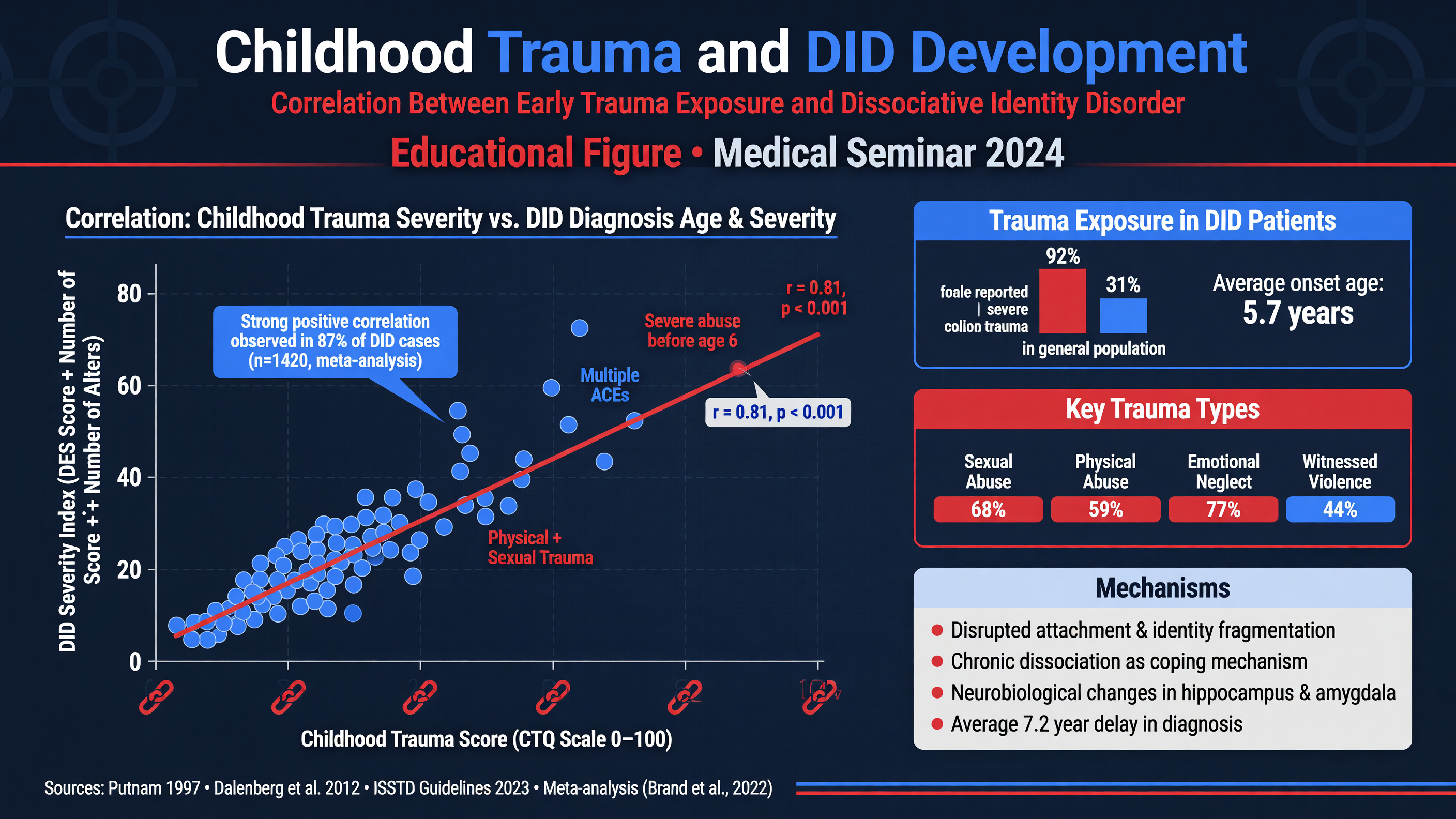
Developmental trauma is the best-supported etiologic contributor to pathological dissociation, especially when threat is early, repeated, interpersonal, inescapable, and linked to a caregiver who is also needed for safety. It is not, however, a DSM diagnostic criterion, a retrospective diagnostic test, or an established necessity in every case. Trauma exposure is insufficient by itself: most maltreated children do not develop DID. Conversely, absence of disclosure or corroboration does not exclude trauma and does not authorize the clinician to infer specific hidden events.
Young children normally move among context-dependent emotional and behavioral states while autobiographical memory, agency, emotion regulation, and narrative identity are developing. DID is therefore better conceptualized as impaired integration during development than as a mature personality that later “split.” Under chronic threat, narrowing awareness, detaching from pain, and restricting access to intolerable experience may preserve attachment and everyday functioning. Repeated state-dependent encoding can make sensations, action tendencies, affects, and autobiographical material more accessible in one arousal state than another.
Caregiver-related trauma creates an approach–avoidance dilemma: the child must seek protection from someone who is frightening, unavailable, disbelieving, or unable to regulate distress. Without dependable co-regulation and language for mental states, attachment-seeking, defensive, ashamed, angry, and everyday-functioning states may remain poorly coordinated. This developmental formulation is plausible and clinically useful; “structural dissociation” should not be mistaken for a demonstrated anatomical partition of the brain.
**Framework:** A developmental diathesis–stress model integrates repeated threat, disrupted caregiving, dissociative susceptibility, sleep and attentional factors, emotion-regulation capacity, metacognitive beliefs, cultural learning, and later reinforcement.
A meta-analysis of 65 studies involving 7,352 maltreated individuals found substantially greater dissociation after abuse or neglect than in comparison groups. Earlier onset, longer duration, and parental abuse were associated with greater severity ([PMID: 29631646](https://pubmed.ncbi.nlm.nih.gov/29631646/)). The outcome was dimensional dissociation, not prospectively diagnosed DID. A 2024 latent-profile study of 3,128 participants similarly linked maltreatment severity with amnesia, depersonalization, derealization, somatoform symptoms, and identity alteration, while also identifying people with severe maltreatment who remained relatively low in dissociation ([PMID: 38739008](https://pubmed.ncbi.nlm.nih.gov/38739008/)). Resilience is therefore part of the data, not an exception to be ignored.
Potential modifiers include absorption, temperament, affective lability, sleep disruption, cognitive control, family environment, and genetic liability for dissociative traits. No “DID gene,” temperament profile, age cutoff, or biomarker has been established. Prospective studies generally track continuous dissociation rather than incident DID; much DID-specific evidence remains retrospective, cross-sectional, female-predominant, and specialty-clinic based.
**Nuance:** The trauma and sociocognitive models need not be treated as absolute opposites. Evidence supports a robust trauma–dissociation association that is not adequately explained by fantasy proneness or suggestibility alone ([PMID: 22409505](https://pubmed.ncbi.nlm.nih.gov/22409505/)). Social media, cultural narratives, therapist expectations, sleep disturbance, and beliefs about memory can nevertheless shape symptom language, state elaboration, visibility, and certainty. Sociocognitive influence is not synonymous with malingering.
Autobiographical memory is reconstructive. Emerging images may be accurate, inaccurate, symbolic, blended, or impossible to verify. Hypnosis, guided imagery, repeated suggestion, and assumptions that healing requires recovered memories can increase confidence without increasing accuracy.
**Decision Point:** When new trauma material emerges, address current safety, affect tolerance, meaning, and functional consequences while documenting its source and corroboration status. The therapist is neither an investigator nor a certifier of historical fact.
**MUST ACT:** Assess ongoing abuse, coercive control, trafficking, unsafe contact, child exposure, and reporting obligations. Do not delay protection while debating the ultimate developmental model.
**Audience Poll:** Which statement is most defensible: trauma proves DID, DID proves childhood abuse, trauma is irrelevant to diagnosis, or developmental trauma is a major but nonspecific risk factor?
---
## Therapeutic Strategies for DID Management
**Duration:** 10 minutes
**Content Tier:** Nuance
Developmental trauma is the best-supported etiologic contributor to pathological dissociation, especially when threat is early, repeated, interpersonal, inescapable, and linked to a caregiver who is also needed for safety. It is not, however, a DSM diagnostic criterion, a retrospective diagnostic test, or an established necessity in every case. Trauma exposure is insufficient by itself: most maltreated children do not develop DID. Conversely, absence of disclosure or corroboration does not exclude trauma and does not authorize the clinician to infer specific hidden events.
Young children normally move among context-dependent emotional and behavioral states while autobiographical memory, agency, emotion regulation, and narrative identity are developing. DID is therefore better conceptualized as impaired integration during development than as a mature personality that later “split.” Under chronic threat, narrowing awareness, detaching from pain, and restricting access to intolerable experience may preserve attachment and everyday functioning. Repeated state-dependent encoding can make sensations, action tendencies, affects, and autobiographical material more accessible in one arousal state than another.
Caregiver-related trauma creates an approach–avoidance dilemma: the child must seek protection from someone who is frightening, unavailable, disbelieving, or unable to regulate distress. Without dependable co-regulation and language for mental states, attachment-seeking, defensive, ashamed, angry, and everyday-functioning states may remain poorly coordinated. This developmental formulation is plausible and clinically useful; “structural dissociation” should not be mistaken for a demonstrated anatomical partition of the brain.
**Framework:** A developmental diathesis–stress model integrates repeated threat, disrupted caregiving, dissociative susceptibility, sleep and attentional factors, emotion-regulation capacity, metacognitive beliefs, cultural learning, and later reinforcement.
A meta-analysis of 65 studies involving 7,352 maltreated individuals found substantially greater dissociation after abuse or neglect than in comparison groups. Earlier onset, longer duration, and parental abuse were associated with greater severity ([PMID: 29631646](https://pubmed.ncbi.nlm.nih.gov/29631646/)). The outcome was dimensional dissociation, not prospectively diagnosed DID. A 2024 latent-profile study of 3,128 participants similarly linked maltreatment severity with amnesia, depersonalization, derealization, somatoform symptoms, and identity alteration, while also identifying people with severe maltreatment who remained relatively low in dissociation ([PMID: 38739008](https://pubmed.ncbi.nlm.nih.gov/38739008/)). Resilience is therefore part of the data, not an exception to be ignored.
Potential modifiers include absorption, temperament, affective lability, sleep disruption, cognitive control, family environment, and genetic liability for dissociative traits. No “DID gene,” temperament profile, age cutoff, or biomarker has been established. Prospective studies generally track continuous dissociation rather than incident DID; much DID-specific evidence remains retrospective, cross-sectional, female-predominant, and specialty-clinic based.
**Nuance:** The trauma and sociocognitive models need not be treated as absolute opposites. Evidence supports a robust trauma–dissociation association that is not adequately explained by fantasy proneness or suggestibility alone ([PMID: 22409505](https://pubmed.ncbi.nlm.nih.gov/22409505/)). Social media, cultural narratives, therapist expectations, sleep disturbance, and beliefs about memory can nevertheless shape symptom language, state elaboration, visibility, and certainty. Sociocognitive influence is not synonymous with malingering.
Autobiographical memory is reconstructive. Emerging images may be accurate, inaccurate, symbolic, blended, or impossible to verify. Hypnosis, guided imagery, repeated suggestion, and assumptions that healing requires recovered memories can increase confidence without increasing accuracy.
**Decision Point:** When new trauma material emerges, address current safety, affect tolerance, meaning, and functional consequences while documenting its source and corroboration status. The therapist is neither an investigator nor a certifier of historical fact.
**MUST ACT:** Assess ongoing abuse, coercive control, trafficking, unsafe contact, child exposure, and reporting obligations. Do not delay protection while debating the ultimate developmental model.
**Audience Poll:** Which statement is most defensible: trauma proves DID, DID proves childhood abuse, trauma is irrelevant to diagnosis, or developmental trauma is a major but nonspecific risk factor?
---
## Therapeutic Strategies for DID Management
 **Duration:** 10 minutes
**Content Tier:** MUST ACT
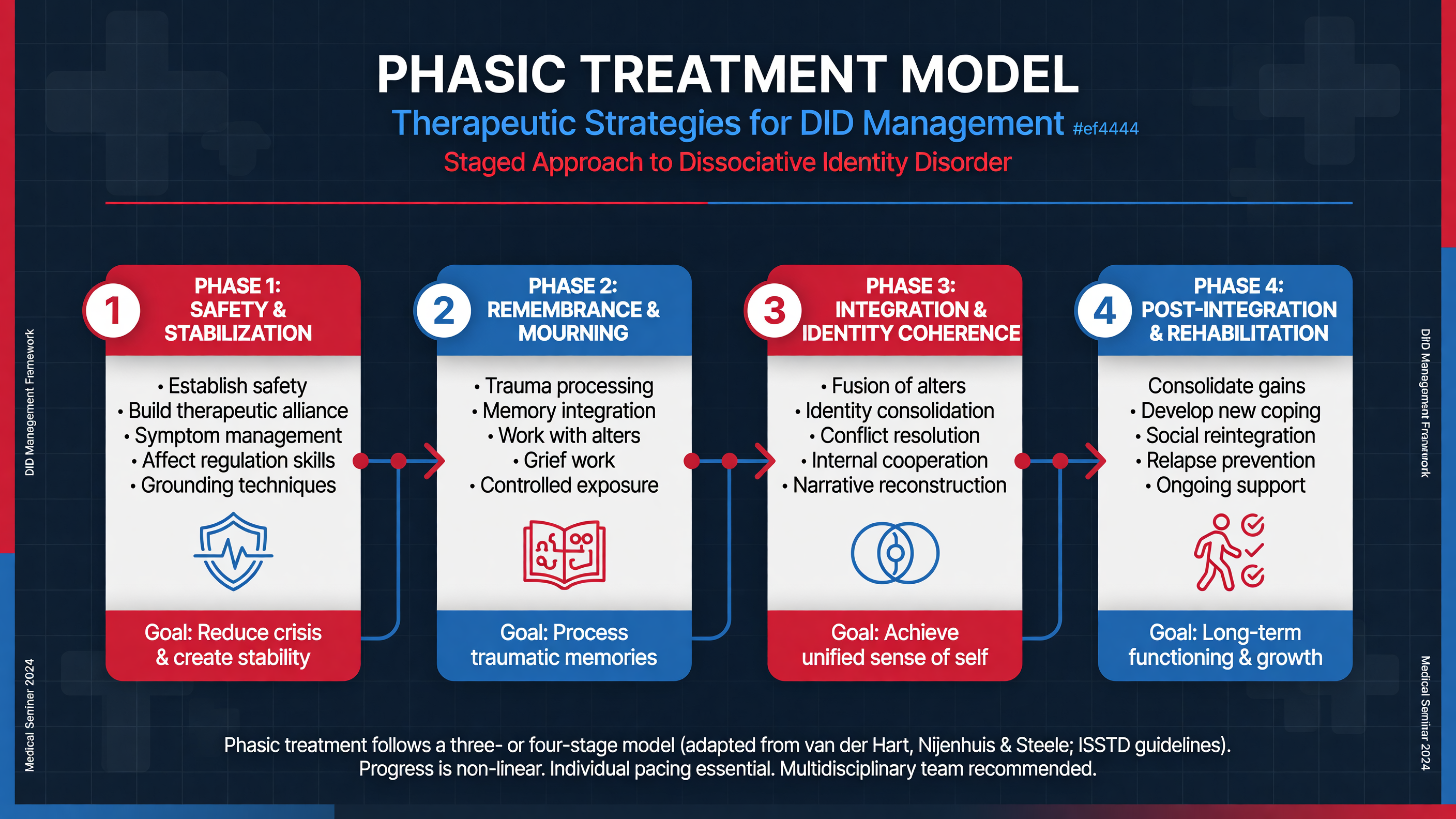
The 2011 ISSTD adult guideline remains the principal specialist consensus document. It recommends phase-oriented psychotherapy but is not equivalent to a high-certainty treatment guideline based on multiple large randomized trials ([PMID: 21391103](https://pubmed.ncbi.nlm.nih.gov/21391103/)). The phases are recursive: stabilization continues during trauma work, and destabilization warrants returning to earlier tasks.
**Phase 1—safety, stabilization, and symptom reduction.** Assess suicide, self-injury, violence, accidental risk during amnesia, ongoing victimization, substance use, eating pathology, sleep deprivation, and medication mismanagement. Build a written safety plan accessible across states: warning signs, internal and external coping steps, crisis contacts, safe locations, transport, and lethal-means restriction. A “no-harm contract” is not a substitute for risk assessment or a higher level of care.
Establish a predictable frame—session length, emergency pathway, between-session contact, confidentiality limits, team communication, medication responsibility, and boundaries around touch. Address self-states respectfully when they emerge or when direct discussion is required for safety, but do not pressure the patient to name, count, map, or elaborate them. Useful continuity tools include a shared calendar, medication log, journal, cue cards, phone reminders, and negotiated internal communication. One body receives one coordinated medication regimen.
**MUST ACT:** Teach present orientation before trauma narration. A practical sequence is: state name, date, and location; identify five visible objects and three sounds; press feet into the floor; describe a safe tactile cue; and use a slower exhalation if breath focus is tolerable. Confirm orientation again before the patient drives or leaves. Eyes-closed imagery, body scans, cold sensations, or breath exercises can themselves trigger some patients, so test each method collaboratively.
DBT-informed distress tolerance, emotion labeling, impulse delay, interpersonal effectiveness, sleep regulation, nutrition, and relapse-prevention skills can strengthen Phase 1. They treat dangerous behaviors and dysregulation; they are not stand-alone evidence-based cures for DID.
**Phase 2—titrated trauma processing.** Readiness means the patient can generally maintain safety, regain present orientation after activation, use skills outside sessions, sustain dual attention, and achieve enough internal cooperation to approach a target without overwhelming objection. Ongoing abuse, uncontrolled substance use, active psychosis, repeated severe destabilization, or inability to contain material are reasons to defer.
Define the target, intensity, time limit, stop signal, grounding method, and post-session plan before processing. Work with limited fragments rather than seeking exhaustive detail or catharsis. The goal is to connect sensory, affective, somatic, and narrative elements with present-day context—not to establish forensic truth. Modified EMDR may be used by clinicians competent in both EMDR and complex dissociation, employing shorter sets, narrow targets, frequent orientation checks, and explicit containment. Standard unmodified protocols, exploratory hypnosis, or prolonged exposure beyond the patient’s regulatory capacity can precipitate flooding, insomnia, self-harm, or functional decline.
**Decision Point:** Escalating NSSI, substance relapse, severe sleep loss, widening amnesia, inability to work, or failure to reorient after sessions means pause the target and restore stabilization. This is dose adjustment, not therapeutic failure.
The evidence base is promising but limited. A 2025 systematic review identified 19 phase-oriented or related studies; most were methodologically weak and adequately powered controlled trials remained scarce ([PMID: 40891466](https://pubmed.ncbi.nlm.nih.gov/40891466/)). In the first randomized trial of complex dissociative disorders, 59 patients received individual therapy with or without twenty 90-minute stabilization-group sessions. The group addition was not immediately superior, although functioning and other symptoms improved over follow-up ([PMID: 35578194](https://pubmed.ncbi.nlm.nih.gov/35578194/)). The uncontrolled TOP DD Network program associated psychoeducation and skills practice with reduced dissociation, PTSD symptoms, and NSSI, with effect sizes of 0.44–0.90 ([PMID: 30698858](https://pubmed.ncbi.nlm.nih.gov/30698858/)).
No medication treats identity discontinuity or dissociative amnesia. Prescribe for a defined comorbidity and measure that target. For PTSD or major depression, sertraline may start at 25–50 mg daily and increase by 25–50 mg at intervals of at least one week toward 50–200 mg/day as tolerated. Screen for bipolar disorder and monitor activation, sexual effects, hyponatremia, bleeding risk, and suicidality. For PTSD nightmares, prazosin may start at 1 mg at bedtime and be titrated cautiously to response while checking standing blood pressure; evidence is mixed, and it is not a global DID treatment. Avoid chronic benzodiazepines when possible because dependence, disinhibition, cognitive impairment, and duplicate dosing can compound amnesia. Reserve antipsychotics for genuine psychosis, mania, or another clear indication rather than escalating them to suppress personified internal voices. Pharmacotherapy evidence across dissociative disorders remains sparse ([PMID: 31470213](https://pubmed.ncbi.nlm.nih.gov/31470213/)).
**Teaching Point:** Outpatient psychotherapy is the default. Hospitalization is indicated for imminent danger, inability to maintain safety, severe self-neglect, intoxication or withdrawal, psychosis or mania, or diagnostic instability requiring containment—not for unplanned trauma excavation.
---
## Recovery and Integration in DID
**Duration:** 10 minutes
**Content Tier:** MUST ACT
The 2011 ISSTD adult guideline remains the principal specialist consensus document. It recommends phase-oriented psychotherapy but is not equivalent to a high-certainty treatment guideline based on multiple large randomized trials ([PMID: 21391103](https://pubmed.ncbi.nlm.nih.gov/21391103/)). The phases are recursive: stabilization continues during trauma work, and destabilization warrants returning to earlier tasks.
**Phase 1—safety, stabilization, and symptom reduction.** Assess suicide, self-injury, violence, accidental risk during amnesia, ongoing victimization, substance use, eating pathology, sleep deprivation, and medication mismanagement. Build a written safety plan accessible across states: warning signs, internal and external coping steps, crisis contacts, safe locations, transport, and lethal-means restriction. A “no-harm contract” is not a substitute for risk assessment or a higher level of care.
Establish a predictable frame—session length, emergency pathway, between-session contact, confidentiality limits, team communication, medication responsibility, and boundaries around touch. Address self-states respectfully when they emerge or when direct discussion is required for safety, but do not pressure the patient to name, count, map, or elaborate them. Useful continuity tools include a shared calendar, medication log, journal, cue cards, phone reminders, and negotiated internal communication. One body receives one coordinated medication regimen.
**MUST ACT:** Teach present orientation before trauma narration. A practical sequence is: state name, date, and location; identify five visible objects and three sounds; press feet into the floor; describe a safe tactile cue; and use a slower exhalation if breath focus is tolerable. Confirm orientation again before the patient drives or leaves. Eyes-closed imagery, body scans, cold sensations, or breath exercises can themselves trigger some patients, so test each method collaboratively.
DBT-informed distress tolerance, emotion labeling, impulse delay, interpersonal effectiveness, sleep regulation, nutrition, and relapse-prevention skills can strengthen Phase 1. They treat dangerous behaviors and dysregulation; they are not stand-alone evidence-based cures for DID.
**Phase 2—titrated trauma processing.** Readiness means the patient can generally maintain safety, regain present orientation after activation, use skills outside sessions, sustain dual attention, and achieve enough internal cooperation to approach a target without overwhelming objection. Ongoing abuse, uncontrolled substance use, active psychosis, repeated severe destabilization, or inability to contain material are reasons to defer.
Define the target, intensity, time limit, stop signal, grounding method, and post-session plan before processing. Work with limited fragments rather than seeking exhaustive detail or catharsis. The goal is to connect sensory, affective, somatic, and narrative elements with present-day context—not to establish forensic truth. Modified EMDR may be used by clinicians competent in both EMDR and complex dissociation, employing shorter sets, narrow targets, frequent orientation checks, and explicit containment. Standard unmodified protocols, exploratory hypnosis, or prolonged exposure beyond the patient’s regulatory capacity can precipitate flooding, insomnia, self-harm, or functional decline.
**Decision Point:** Escalating NSSI, substance relapse, severe sleep loss, widening amnesia, inability to work, or failure to reorient after sessions means pause the target and restore stabilization. This is dose adjustment, not therapeutic failure.
The evidence base is promising but limited. A 2025 systematic review identified 19 phase-oriented or related studies; most were methodologically weak and adequately powered controlled trials remained scarce ([PMID: 40891466](https://pubmed.ncbi.nlm.nih.gov/40891466/)). In the first randomized trial of complex dissociative disorders, 59 patients received individual therapy with or without twenty 90-minute stabilization-group sessions. The group addition was not immediately superior, although functioning and other symptoms improved over follow-up ([PMID: 35578194](https://pubmed.ncbi.nlm.nih.gov/35578194/)). The uncontrolled TOP DD Network program associated psychoeducation and skills practice with reduced dissociation, PTSD symptoms, and NSSI, with effect sizes of 0.44–0.90 ([PMID: 30698858](https://pubmed.ncbi.nlm.nih.gov/30698858/)).
No medication treats identity discontinuity or dissociative amnesia. Prescribe for a defined comorbidity and measure that target. For PTSD or major depression, sertraline may start at 25–50 mg daily and increase by 25–50 mg at intervals of at least one week toward 50–200 mg/day as tolerated. Screen for bipolar disorder and monitor activation, sexual effects, hyponatremia, bleeding risk, and suicidality. For PTSD nightmares, prazosin may start at 1 mg at bedtime and be titrated cautiously to response while checking standing blood pressure; evidence is mixed, and it is not a global DID treatment. Avoid chronic benzodiazepines when possible because dependence, disinhibition, cognitive impairment, and duplicate dosing can compound amnesia. Reserve antipsychotics for genuine psychosis, mania, or another clear indication rather than escalating them to suppress personified internal voices. Pharmacotherapy evidence across dissociative disorders remains sparse ([PMID: 31470213](https://pubmed.ncbi.nlm.nih.gov/31470213/)).
**Teaching Point:** Outpatient psychotherapy is the default. Hospitalization is indicated for imminent danger, inability to maintain safety, severe self-neglect, intoxication or withdrawal, psychosis or mania, or diagnostic instability requiring containment—not for unplanned trauma excavation.
---
## Recovery and Integration in DID
 **Duration:** 10 minutes
**Content Tier:** Teaching Point
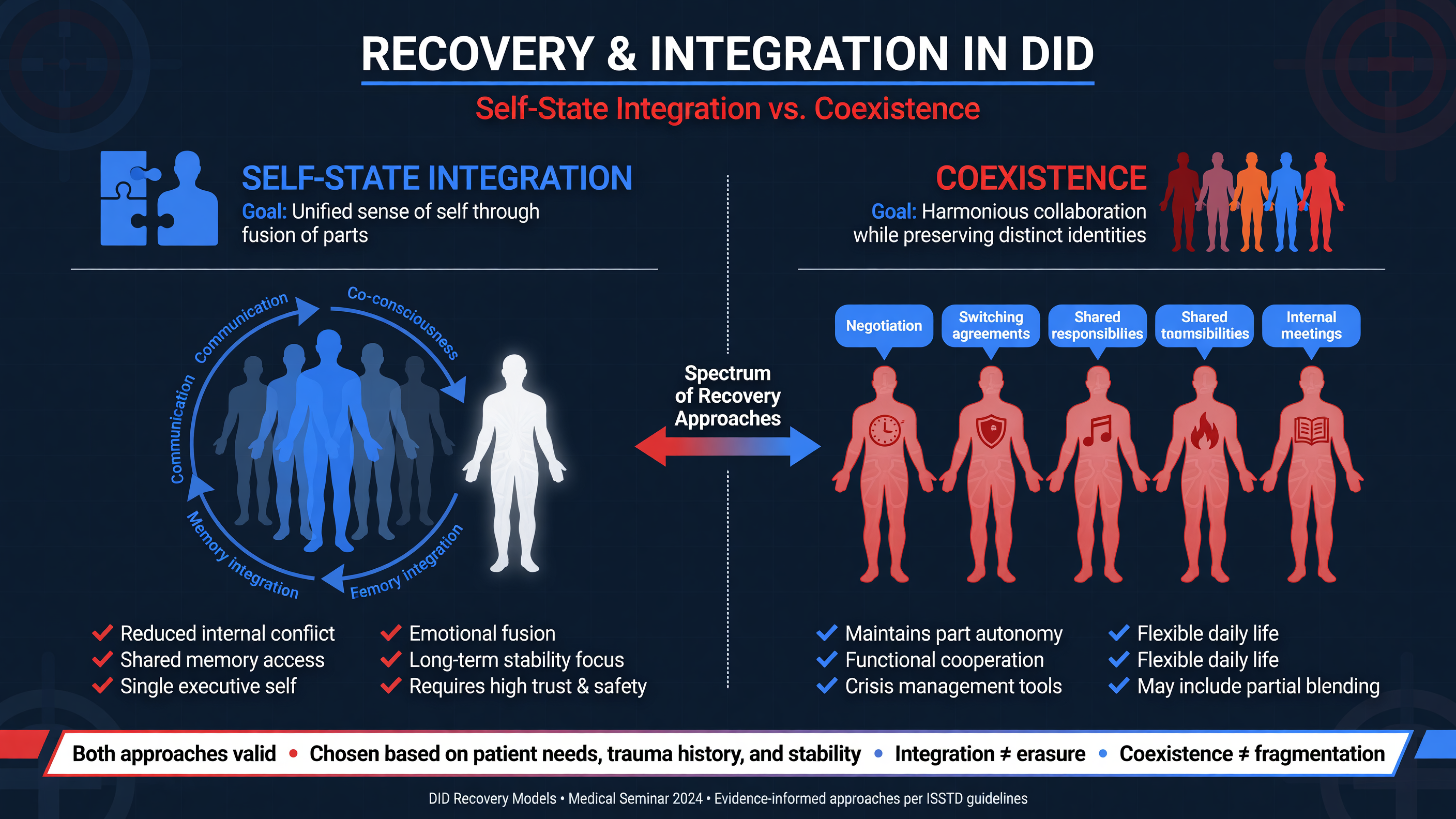
Integration is a process, not a single event. It includes improved communication, shared access to information needed for daily life, reduced amnesia, less involuntary switching, greater ownership of thoughts and actions, and a more continuous sense of agency. *Fusion* refers to the subjective joining of self-states; *final fusion* describes a sustained experience of one unified identity. These terms should not be used interchangeably.
Some patients desire final fusion. Others prefer stable cooperation or “functional multiplicity.” Either can be a legitimate outcome if the person is safe, accepts whole-person responsibility, can coordinate decisions, has sufficient continuity of memory, and functions durably in relationships, work, education, and health care. Continued high-risk amnesia, hidden self-harm, contradictory medication use, or recurrent loss of control is not functional recovery merely because the patient prefers coexistence.
**Teaching Point:** Fusion should not be framed as killing, erasing, or defeating parts. Therapy seeks greater connection and adaptive flexibility while preserving the memories, capacities, meanings, and protective intentions represented across self-states.
Phase 3 therefore extends beyond identity structure. Patients may need to grieve lost childhood, abandoned relationships, disability, or years spent misdiagnosed. Rehabilitation addresses intimacy, parenting, sexuality, education, employment, finances, sleep, physical health, substance recovery, and ordinary pleasure. A patient who reports fewer switches but remains isolated, unemployed, medically neglectful, or repeatedly suicidal has not achieved an adequate outcome.
**Framework:** Measure recovery across five domains: safety, continuity, symptom burden, participation, and quality of life. Track suicide attempts, NSSI, emergency visits, hospitalization, revictimization, substance use, sleep, medication adherence, work or school participation, relationships, and patient-defined goals. The DES-II, MID, PTSD Checklist, PHQ-9, Columbia Suicide Severity Rating Scale, and WHODAS 2.0 can support measurement, but changes must be interpreted alongside function and clinical interview.
Naturalistic studies suggest that specialized treatment can reduce dissociation, PTSD symptoms, depression, self-harm, hospitalization, and revictimization. At six-year follow-up in the TOP DD cohort, therapist reports described fewer hospitalizations and stressors, less sexual revictimization, and better global functioning ([PMID: 28680542](https://pubmed.ncbi.nlm.nih.gov/28680542/)). The findings are encouraging but cannot establish efficacy because the study lacked randomization, had substantial attrition, and relied partly on therapist reporting. Older literature associated successful integration with lower symptom burden, but severity, selection, and treatment-duration confounding prevent concluding that fusion itself caused the improvement ([PMID: 19752643](https://pubmed.ncbi.nlm.nih.gov/19752643/)).
**Nuance:** Apparent fusion may not remain stable under severe stress. Conversely, temporary increases in awareness of self-states can occur as amnestic barriers lessen and need not represent deterioration. Interpret symptom counts in context: increased awareness with improved safety and continuity may be progress.
Relapse prevention should identify anniversaries, family contact, caregiving stress, childbirth, medical procedures, sleep deprivation, substance exposure, therapist absence, and relationship threats. Plans should specify early warning signs, grounding routines, medication safeguards, social supports, and how to re-enter more intensive treatment. Periodic booster sessions may be appropriate.
**Decision Point:** If trauma processing improves PTSD but worsens amnesia, self-harm, or daily functioning, slow the work and restore coordination. If stabilization becomes indefinite avoidance despite sustained safety and capacity, collaboratively reconsider whether carefully dosed processing is now appropriate.
Therapist factors matter. Rescue fantasies, fear of the diagnosis, fascination with self-states, inconsistent boundaries, and adversarial skepticism can all impair care. Regular consultation helps clinicians preserve empathy, epistemic humility, and a unified treatment plan.
**Audience Poll:** If a patient has stable cooperation, no dangerous amnesia, restored function, and no desire for final fusion, what additional clinical benefit would justify making fusion mandatory?
---
## Case Studies and Clinical Implications
**Duration:** 10 minutes
**Content Tier:** Teaching Point
Integration is a process, not a single event. It includes improved communication, shared access to information needed for daily life, reduced amnesia, less involuntary switching, greater ownership of thoughts and actions, and a more continuous sense of agency. *Fusion* refers to the subjective joining of self-states; *final fusion* describes a sustained experience of one unified identity. These terms should not be used interchangeably.
Some patients desire final fusion. Others prefer stable cooperation or “functional multiplicity.” Either can be a legitimate outcome if the person is safe, accepts whole-person responsibility, can coordinate decisions, has sufficient continuity of memory, and functions durably in relationships, work, education, and health care. Continued high-risk amnesia, hidden self-harm, contradictory medication use, or recurrent loss of control is not functional recovery merely because the patient prefers coexistence.
**Teaching Point:** Fusion should not be framed as killing, erasing, or defeating parts. Therapy seeks greater connection and adaptive flexibility while preserving the memories, capacities, meanings, and protective intentions represented across self-states.
Phase 3 therefore extends beyond identity structure. Patients may need to grieve lost childhood, abandoned relationships, disability, or years spent misdiagnosed. Rehabilitation addresses intimacy, parenting, sexuality, education, employment, finances, sleep, physical health, substance recovery, and ordinary pleasure. A patient who reports fewer switches but remains isolated, unemployed, medically neglectful, or repeatedly suicidal has not achieved an adequate outcome.
**Framework:** Measure recovery across five domains: safety, continuity, symptom burden, participation, and quality of life. Track suicide attempts, NSSI, emergency visits, hospitalization, revictimization, substance use, sleep, medication adherence, work or school participation, relationships, and patient-defined goals. The DES-II, MID, PTSD Checklist, PHQ-9, Columbia Suicide Severity Rating Scale, and WHODAS 2.0 can support measurement, but changes must be interpreted alongside function and clinical interview.
Naturalistic studies suggest that specialized treatment can reduce dissociation, PTSD symptoms, depression, self-harm, hospitalization, and revictimization. At six-year follow-up in the TOP DD cohort, therapist reports described fewer hospitalizations and stressors, less sexual revictimization, and better global functioning ([PMID: 28680542](https://pubmed.ncbi.nlm.nih.gov/28680542/)). The findings are encouraging but cannot establish efficacy because the study lacked randomization, had substantial attrition, and relied partly on therapist reporting. Older literature associated successful integration with lower symptom burden, but severity, selection, and treatment-duration confounding prevent concluding that fusion itself caused the improvement ([PMID: 19752643](https://pubmed.ncbi.nlm.nih.gov/19752643/)).
**Nuance:** Apparent fusion may not remain stable under severe stress. Conversely, temporary increases in awareness of self-states can occur as amnestic barriers lessen and need not represent deterioration. Interpret symptom counts in context: increased awareness with improved safety and continuity may be progress.
Relapse prevention should identify anniversaries, family contact, caregiving stress, childbirth, medical procedures, sleep deprivation, substance exposure, therapist absence, and relationship threats. Plans should specify early warning signs, grounding routines, medication safeguards, social supports, and how to re-enter more intensive treatment. Periodic booster sessions may be appropriate.
**Decision Point:** If trauma processing improves PTSD but worsens amnesia, self-harm, or daily functioning, slow the work and restore coordination. If stabilization becomes indefinite avoidance despite sustained safety and capacity, collaboratively reconsider whether carefully dosed processing is now appropriate.
Therapist factors matter. Rescue fantasies, fear of the diagnosis, fascination with self-states, inconsistent boundaries, and adversarial skepticism can all impair care. Regular consultation helps clinicians preserve empathy, epistemic humility, and a unified treatment plan.
**Audience Poll:** If a patient has stable cooperation, no dangerous amnesia, restored function, and no desire for final fusion, what additional clinical benefit would justify making fusion mandatory?
---
## Case Studies and Clinical Implications
 **Duration:** 20 minutes
**Content Tier:** MUST ACT
The following composite case illustrates clinical reasoning rather than a prescriptive protocol.
Avery, a 31-year-old school administrator, is brought to the emergency department after being found 40 miles from home with superficial forearm lacerations and no memory of leaving work. Their phone contains messages written in a markedly different tone, including “I cannot keep doing this.” Prior diagnoses include BPD, bipolar II disorder, and unspecified psychosis. Current medications are quetiapine 400 mg nightly, clonazepam as needed, and three partially used antidepressant bottles. Avery reports internal arguing voices, nightmares, periods of feeling unreal, and occasions when “my body carries on while I watch.” They are ashamed and initially deny “blackouts.”
**MUST ACT:** The emergency task is safety, not proving DID. Avery is interviewed in a quiet room, oriented to date and place, assessed for injuries and intoxication, and asked whether any part of them has suicidal intent, a plan, hidden medication, or access to firearms. The clinician does not request a switch. Collateral from Avery’s partner reveals two recent episodes of unexplained travel and concern that medication has sometimes been taken twice. Because Avery cannot establish a reliable safety plan and another self-state appears to have prepared for self-harm, voluntary admission is arranged with restricted medication access.
Examination shows no delirium, focal neurologic deficit, sustained formal thought disorder, fixed delusion, or negative symptoms. Toxicology and targeted laboratory testing are unrevealing. The hours-long, context-linked episodes lack stereotyped automatisms or postictal features, so emergency EEG and neuroimaging are not ordered. Neurology review remains available if spell characteristics change.
During four outpatient diagnostic sessions, the clinician reconstructs a timeline using records and collateral. Avery has no history of a distinct four-day hypomanic syndrome: reported “highs” last minutes to hours, follow interpersonal triggers, and are accompanied by discontinuity and later amnesia. The voices frequently comment on immediate danger or argue about self-harm, while reality testing remains intact. This does not exclude psychosis, but the overall course does not support a primary schizophrenia-spectrum illness. Avery meets PTSD criteria and has chronic interpersonal sensitivity, but recurrent changes in agency plus everyday and autobiographical amnesia are not explained by BPD alone. A DES-II screen is elevated, and a SCID-D interview confirms severe amnesia, depersonalization, identity confusion, and identity alteration. DID, PTSD, and recurrent major depression are diagnosed; BPD traits are retained in the formulation rather than erased.
**Teaching Point:** The diagnosis rests on longitudinal convergence and exclusions—not the messages, voices, trauma history, screening score, or observed demeanor alone.
Phase 1 treatment consists of weekly 60-minute psychotherapy, a shared safety plan, means restriction, one pharmacy, blister-packed medication, a daily medication log, sleep stabilization, DBT-informed distress-tolerance skills, and a shared calendar. Quetiapine is gradually reduced because no psychotic or bipolar indication is established and daytime sedation is impairing function; clonazepam is tapered cautiously rather than stopped abruptly. Sertraline begins at 25 mg/day, increases to 50 mg after one week, and reaches 100 mg/day by week six for major depression and PTSD—not for DID. A grounding card reads: “My name is Avery; today is ___; I am in ___; the danger is not happening now; press both feet down and name five blue objects.”
Self-states are addressed when they emerge, particularly around safety, but the therapist does not assign names or roles. A shared journal reveals that one state hides medication to prevent overdose while another hoards it, allowing the team to replace secrecy with locked, supervised dispensing. At six months, Avery has had no further emergency visits, has returned to work part-time, and usually detects disorientation before losing hours.
**Decision Point:** At month eight, trauma processing begins only after Avery demonstrates reliable grounding, reduced NSSI urges, shared agreement about the target, and an after-session transport plan. Processing is limited to brief fragments and bracketed by orientation. When family contact produces insomnia and renewed cutting urges, processing pauses for three weeks while stabilization is intensified.
At 18 months, Avery reports greater co-consciousness, only brief memory gaps, no self-harm for nine months, improved depression, and full-time work. The preferred goal is functional cooperation rather than final fusion. Continued therapy addresses relational trust, grief, and relapse prevention.
**Nuance:** This is meaningful recovery without a cinematic disappearance of self-states. The decisive outcomes are safety, continuity, agency, and participation.
**Audience Poll:** At the initial emergency visit, which intervention would be most harmful: means restriction, quiet reorientation, collateral history, or detailed trauma excavation intended to identify every self-state?
---
## Tonight on Shift
- **Establish immediate safety.** Assess suicide, NSSI, violence, accidental risk during amnesia, medication duplication, intoxication or withdrawal, ongoing abuse, lethal means, and whether another self-state may hold undisclosed intent.
- **Describe before diagnosing.** Document identity discontinuity, altered agency, amnesia beyond ordinary forgetting, duration, triggers, collateral observations, impairment, and cultural context; avoid inducing switches or supplying elaborate labels.
- **Exclude dangerous mimics.** Evaluate delirium, focal seizures, TBI, neurocognitive disease, parasomnia, substances, psychosis, and syndromal mania according to the presentation—not through a reflexive universal test panel.
- **Orient and stabilize.** Use the patient’s name, date, location, sensory grounding, feet-to-floor pressure, a written crisis plan, means restriction, and a clear follow-up pathway. Do not excavate trauma in the emergency setting.
- **Coordinate one treatment system.** Use one lead clinician, one prescriber, one pharmacy, a shared medication record, explicit boundaries, and phase-oriented psychotherapy. Prescribe for defined comorbid targets, not identity states.
- **Measure functional recovery.** Track amnesia, self-harm, hospitalization, substance use, sleep, medication safety, work or school, relationships, and quality of life. Support final fusion or functional cooperation according to patient preference and durable safety.
**Duration:** 20 minutes
**Content Tier:** MUST ACT
The following composite case illustrates clinical reasoning rather than a prescriptive protocol.
Avery, a 31-year-old school administrator, is brought to the emergency department after being found 40 miles from home with superficial forearm lacerations and no memory of leaving work. Their phone contains messages written in a markedly different tone, including “I cannot keep doing this.” Prior diagnoses include BPD, bipolar II disorder, and unspecified psychosis. Current medications are quetiapine 400 mg nightly, clonazepam as needed, and three partially used antidepressant bottles. Avery reports internal arguing voices, nightmares, periods of feeling unreal, and occasions when “my body carries on while I watch.” They are ashamed and initially deny “blackouts.”
**MUST ACT:** The emergency task is safety, not proving DID. Avery is interviewed in a quiet room, oriented to date and place, assessed for injuries and intoxication, and asked whether any part of them has suicidal intent, a plan, hidden medication, or access to firearms. The clinician does not request a switch. Collateral from Avery’s partner reveals two recent episodes of unexplained travel and concern that medication has sometimes been taken twice. Because Avery cannot establish a reliable safety plan and another self-state appears to have prepared for self-harm, voluntary admission is arranged with restricted medication access.
Examination shows no delirium, focal neurologic deficit, sustained formal thought disorder, fixed delusion, or negative symptoms. Toxicology and targeted laboratory testing are unrevealing. The hours-long, context-linked episodes lack stereotyped automatisms or postictal features, so emergency EEG and neuroimaging are not ordered. Neurology review remains available if spell characteristics change.
During four outpatient diagnostic sessions, the clinician reconstructs a timeline using records and collateral. Avery has no history of a distinct four-day hypomanic syndrome: reported “highs” last minutes to hours, follow interpersonal triggers, and are accompanied by discontinuity and later amnesia. The voices frequently comment on immediate danger or argue about self-harm, while reality testing remains intact. This does not exclude psychosis, but the overall course does not support a primary schizophrenia-spectrum illness. Avery meets PTSD criteria and has chronic interpersonal sensitivity, but recurrent changes in agency plus everyday and autobiographical amnesia are not explained by BPD alone. A DES-II screen is elevated, and a SCID-D interview confirms severe amnesia, depersonalization, identity confusion, and identity alteration. DID, PTSD, and recurrent major depression are diagnosed; BPD traits are retained in the formulation rather than erased.
**Teaching Point:** The diagnosis rests on longitudinal convergence and exclusions—not the messages, voices, trauma history, screening score, or observed demeanor alone.
Phase 1 treatment consists of weekly 60-minute psychotherapy, a shared safety plan, means restriction, one pharmacy, blister-packed medication, a daily medication log, sleep stabilization, DBT-informed distress-tolerance skills, and a shared calendar. Quetiapine is gradually reduced because no psychotic or bipolar indication is established and daytime sedation is impairing function; clonazepam is tapered cautiously rather than stopped abruptly. Sertraline begins at 25 mg/day, increases to 50 mg after one week, and reaches 100 mg/day by week six for major depression and PTSD—not for DID. A grounding card reads: “My name is Avery; today is ___; I am in ___; the danger is not happening now; press both feet down and name five blue objects.”
Self-states are addressed when they emerge, particularly around safety, but the therapist does not assign names or roles. A shared journal reveals that one state hides medication to prevent overdose while another hoards it, allowing the team to replace secrecy with locked, supervised dispensing. At six months, Avery has had no further emergency visits, has returned to work part-time, and usually detects disorientation before losing hours.
**Decision Point:** At month eight, trauma processing begins only after Avery demonstrates reliable grounding, reduced NSSI urges, shared agreement about the target, and an after-session transport plan. Processing is limited to brief fragments and bracketed by orientation. When family contact produces insomnia and renewed cutting urges, processing pauses for three weeks while stabilization is intensified.
At 18 months, Avery reports greater co-consciousness, only brief memory gaps, no self-harm for nine months, improved depression, and full-time work. The preferred goal is functional cooperation rather than final fusion. Continued therapy addresses relational trust, grief, and relapse prevention.
**Nuance:** This is meaningful recovery without a cinematic disappearance of self-states. The decisive outcomes are safety, continuity, agency, and participation.
**Audience Poll:** At the initial emergency visit, which intervention would be most harmful: means restriction, quiet reorientation, collateral history, or detailed trauma excavation intended to identify every self-state?
---
## Tonight on Shift
- **Establish immediate safety.** Assess suicide, NSSI, violence, accidental risk during amnesia, medication duplication, intoxication or withdrawal, ongoing abuse, lethal means, and whether another self-state may hold undisclosed intent.
- **Describe before diagnosing.** Document identity discontinuity, altered agency, amnesia beyond ordinary forgetting, duration, triggers, collateral observations, impairment, and cultural context; avoid inducing switches or supplying elaborate labels.
- **Exclude dangerous mimics.** Evaluate delirium, focal seizures, TBI, neurocognitive disease, parasomnia, substances, psychosis, and syndromal mania according to the presentation—not through a reflexive universal test panel.
- **Orient and stabilize.** Use the patient’s name, date, location, sensory grounding, feet-to-floor pressure, a written crisis plan, means restriction, and a clear follow-up pathway. Do not excavate trauma in the emergency setting.
- **Coordinate one treatment system.** Use one lead clinician, one prescriber, one pharmacy, a shared medication record, explicit boundaries, and phase-oriented psychotherapy. Prescribe for defined comorbid targets, not identity states.
- **Measure functional recovery.** Track amnesia, self-harm, hospitalization, substance use, sleep, medication safety, work or school, relationships, and quality of life. Support final fusion or functional cooperation according to patient preference and durable safety.