Heart Failure Post-MI: Beta-Blockers & SGLT2i
Rethinking the post-MI toolkit
Cardiology · Seminar week 13 · released June 15, 2026 · includes a discussion video
SGLT2 inhibitors are reshaping heart failure management. Combined with optimized beta-blockade, the post-MI landscape is evolving rapidly.
Learning Objectives
- Discuss the updated guidelines for beta-blocker use post-MI in varied ejection fraction categories.
- Analyze the results and implications of the recent SGLT2 inhibitors meta-analysis across the cardiometabolic spectrum.
- Identify key patient profiles that benefit most from each therapeutic strategy.
- Apply evidence-based practices in formulating guideline-directed medical therapy (GDMT) plans for heart failure post-MI.
Section 1: Overview of Heart Failure Management Post-Myocardial Infarction
Duration: 10 minutes Content Tier: Teaching Point
%%FIG0%% Teaching Point: Heart failure following myocardial infarction represents one of the most consequential complications in modern cardiology. Understanding the pathophysiological cascade from acute myocardial injury to chronic ventricular dysfunction is the foundation upon which all subsequent therapeutic decisions are built.
When a coronary artery occludes, the downstream myocardium undergoes ischemic injury and necrosis. The extent of irreversible damage depends on the duration of ischemia, the territory supplied, and the presence of collateral circulation. Within hours, the infarcted zone begins to thin and expand — a process called infarct expansion. Over weeks to months, the non-infarcted myocardium undergoes compensatory hypertrophy and the entire left ventricle remodels, often assuming a spherical geometry that is mechanically disadvantageous (PMID: 40892608).
This remodeling process is driven by neurohormonal activation. The renin-angiotensin-aldosterone system (RAAS) activates in response to reduced cardiac output and renal hypoperfusion. Sympathetic nervous system activation increases circulating catecholamines. While these responses are initially compensatory — maintaining perfusion pressure and cardiac output — chronic neurohormonal activation becomes maladaptive. Angiotensin II promotes fibrosis, aldosterone causes sodium retention and further fibrosis, and sustained catecholamine exposure leads to beta-receptor downregulation, myocyte apoptosis, and arrhythmogenesis.
Say Out Loud: "After a myocardial infarction, the heart doesn't just lose muscle — it undergoes a cascading remodeling process driven by neurohormonal activation. Every pharmacological intervention we discuss today targets a specific arm of that maladaptive response."
Current Guidelines: AHA/ACC/HFSA 2022
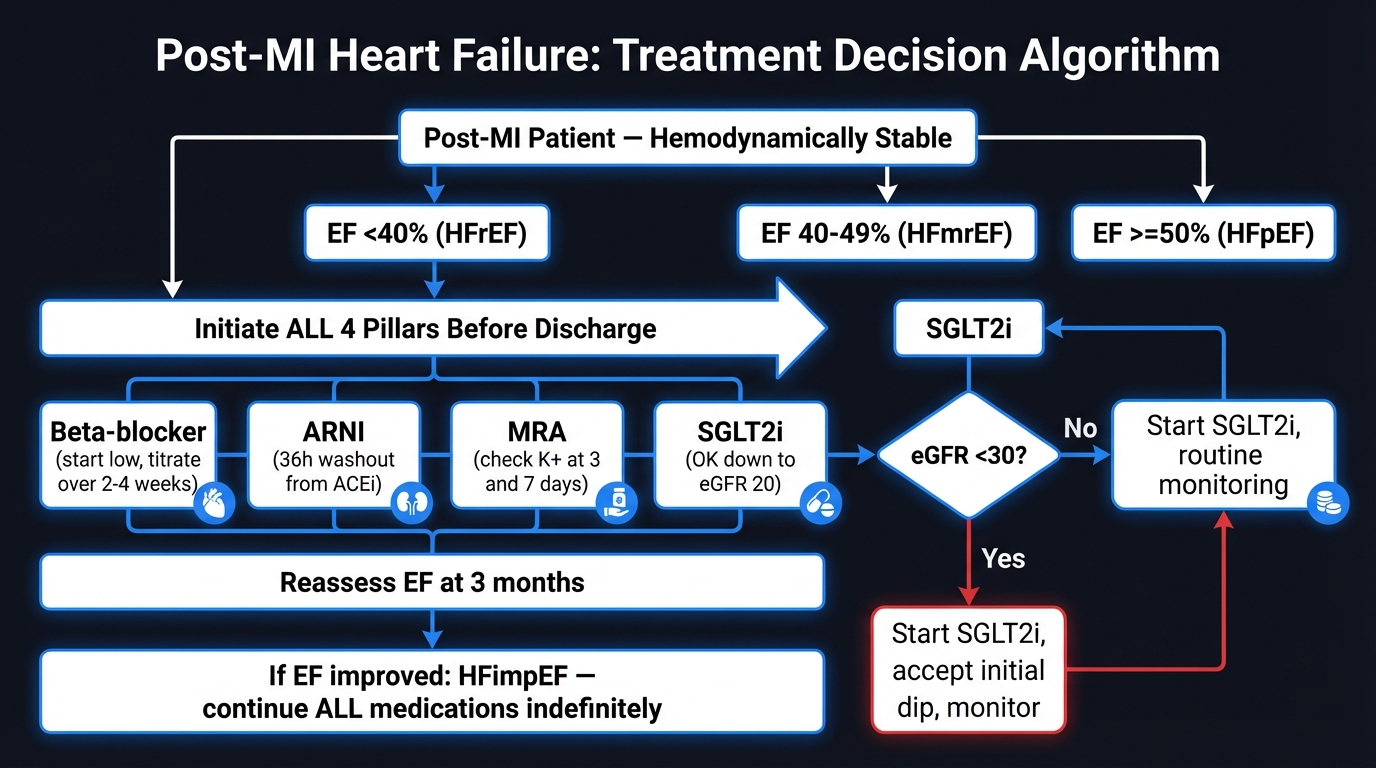
The 2022 AHA/ACC/HFSA Heart Failure Guidelines established a clear framework for managing heart failure with reduced ejection fraction (HFrEF), codifying what is now termed guideline-directed medical therapy (GDMT). The four-pillar approach includes:
- Beta-blockers (carvedilol, metoprolol succinate, or bisoprolol) — Class I, Level of Evidence A
- ACE inhibitors/ARBs or ARNI (sacubitril/valsartan preferred) — Class I, Level of Evidence A
- Mineralocorticoid receptor antagonists (MRAs) (spironolactone or eplerenone) — Class I, Level of Evidence A
- SGLT2 inhibitors (dapagliflozin or empagliflozin) — Class I, Level of Evidence A
This represents a paradigm shift. SGLT2 inhibitors were added as the fourth pillar based on landmark trials demonstrating mortality and hospitalization benefits independent of diabetes status (PMID: 31535829). The 2022 Canadian Cardiovascular Society guidelines similarly endorsed SGLT2 inhibitors for cardiorenal risk reduction (PMID: 35961754).
Nuance: The guidelines recommend initiating all four pillars as rapidly as tolerable rather than sequential up-titration. The STRONG-HF trial demonstrated that rapid titration to target doses within two weeks of discharge reduced 180-day heart failure hospitalization and death. However, real-world implementation remains challenging — registry data consistently show that fewer than 25% of eligible patients receive all four drug classes at target doses.
Audience Poll
What do you consider the biggest barrier to achieving full GDMT in your post-MI patients?
- A) Hypotension limiting titration
- B) Renal function concerns
- C) Patient adherence / polypharmacy
- D) Lack of awareness of updated guidelines
- E) System-level barriers (discharge protocols, follow-up gaps)
Section 2: Role of Beta-Blockers in Heart Failure — New Insights from Meta-Analyses
Duration: 15 minutes Content Tier: MUST ACT
%%FIG1%% MUST ACT: Beta-blockers have been a cornerstone of heart failure management for over two decades, but the evidence base has evolved substantially. The updated network meta-analysis by van Essen et al. (2025) analyzed 103,754 patients across 89 randomized controlled trials and provides the most comprehensive assessment of combination pharmacotherapy in HFrEF to date (PMID: 40892608).
Key Findings from the Updated Network Meta-Analysis
The analysis demonstrated that relative to placebo, quadruple therapy with ARNI, beta-blockers, MRAs, and SGLT2 inhibitors reduced all-cause mortality with a hazard ratio of 0.39 (95% CI: 0.32-0.49). Even more striking, quintuple therapy adding vericiguat achieved a hazard ratio of 0.35 (95% CI: 0.27-0.45) for all-cause mortality (PMID: 40892608).
Teaching Point: To put these numbers in clinical perspective: for a representative 70-year-old patient with HFrEF, quadruple therapy (ARNI/beta-blockers/MRAs/SGLT2i) provided 5.3 additional life-years compared to placebo. This is an extraordinary magnitude of benefit, reinforcing that each component of GDMT contributes meaningfully to survival.
Beta-Blockers Across the EF Spectrum
The role of beta-blockers in HFrEF (EF less than 40%) is firmly established. However, their benefit in heart failure with mildly reduced ejection fraction (HFmrEF, EF 40-49%) has been a subject of ongoing investigation. An individual patient data (IPD) meta-analysis of randomized controlled trials specifically examined beta-blocker efficacy in post-MI patients with mildly reduced EF (PMID: 40892608).
Decision Point: When a post-MI patient has an EF of 42% — technically HFmrEF — should you initiate beta-blocker therapy?
The data support yes. The IPD meta-analysis demonstrated that beta-blockers reduced all-cause mortality and heart failure hospitalization in patients with mildly reduced EF, albeit with more modest effect sizes compared to HFrEF. The 2022 guidelines provide a Class IIa recommendation for beta-blockers in HFmrEF. For post-MI patients specifically, the benefit-to-risk ratio favors treatment regardless of whether EF falls just above or below the 40% threshold.
Say Out Loud: "Don't get hung up on the 40% cutoff. If your post-MI patient has an EF of 42%, they still benefit from a beta-blocker. The pathophysiology doesn't change at an arbitrary number."
Which Beta-Blocker?
Not all beta-blockers are created equal in heart failure. Only three have robust evidence for mortality reduction in HFrEF:
| Beta-Blocker | Trial | Target Dose | Key Feature |
|---|---|---|---|
| Carvedilol | COPERNICUS, COMET | 25 mg BID | Alpha-1 blockade (vasodilation), antioxidant properties |
| Metoprolol succinate | MERIT-HF | 200 mg daily | Beta-1 selective, extended release |
| Bisoprolol | CIBIS-II | 10 mg daily | Most beta-1 selective, renal clearance |
Nuance: The COMET trial directly compared carvedilol to metoprolol tartrate (short-acting, not succinate) and found carvedilol superior for all-cause mortality (HR 0.83, 95% CI 0.74-0.93). However, this was a comparison with the inferior formulation of metoprolol. There is no head-to-head trial comparing carvedilol to metoprolol succinate. In practice, the choice often depends on patient-specific factors: carvedilol offers additional afterload reduction through alpha-blockade, which may benefit hypertensive patients, while bisoprolol's renal clearance makes it preferable in hepatic dysfunction.
The CPIC pharmacogenomics guideline for beta-blocker therapy highlights that CYP2D6 genotype significantly influences metoprolol metabolism. Poor metabolizers of CYP2D6 may have substantially higher metoprolol levels, increasing risk of bradycardia and hypotension. While routine genotyping is not yet standard of care, awareness of this pharmacogenomic interaction is increasingly relevant (PMID: 38951961).
Practical Considerations for Beta-Blocker Initiation Post-MI
Teaching Point: Beta-blockers should be initiated before hospital discharge in hemodynamically stable post-MI patients with reduced EF, even if the EF is expected to recover. Start low and titrate to target doses over 2-4 weeks in the outpatient setting.
Contraindications to initiate or continue therapy:
- Heart rate below 50 beats per minute
- Systolic blood pressure below 90 mmHg
- Symptomatic bradycardia or heart block (without pacemaker)
- Active decompensated heart failure requiring inotropic support
- Severe reactive airway disease (relative; cardioselective agents may be used cautiously)
Say Out Loud: "Start the beta-blocker before discharge. Don't wait for the outpatient appointment — that's when patients fall through the cracks."
Audience Poll
A 58-year-old post-MI patient has an EF of 38% and is hemodynamically stable. Their resting heart rate is 62 bpm. Which beta-blocker would you start?
- A) Carvedilol 3.125 mg BID
- B) Metoprolol succinate 12.5 mg daily
- C) Bisoprolol 1.25 mg daily
- D) Atenolol 25 mg daily
- E) I would defer beta-blocker initiation given the heart rate
Section 3: Understanding SGLT2 Inhibitors — Mechanisms and Clinical Benefits
Duration: 15 minutes Content Tier: Teaching Point
%%FIG2%% Teaching Point: SGLT2 inhibitors have transformed heart failure management more rapidly than any drug class in recent memory. Developed initially as glucose-lowering agents for type 2 diabetes, their cardiovascular and renal benefits have proven to be class-defining properties that extend far beyond glycemic control.
Mechanism of Action — Beyond Glucose
Sodium-glucose cotransporter 2 (SGLT2) is expressed in the S1 segment of the renal proximal tubule and is responsible for reabsorbing approximately 90% of filtered glucose. SGLT2 inhibitors block this transporter, causing glycosuria of 60-80 grams per day and an accompanying osmotic diuresis. However, this glycosuric effect explains only a fraction of the cardiovascular benefit (PMID: 38768620).
The cardioprotective mechanisms are multi-dimensional and include:
- Hemodynamic effects: Osmotic diuresis and natriuresis reduce plasma volume and preload without activating the RAAS — a critical distinction from loop diuretics. Interstitial fluid is preferentially mobilized over intravascular volume, reducing congestion while maintaining effective circulating volume.
- Metabolic shift: SGLT2 inhibitors promote a metabolic switch from glucose and fatty acid oxidation to ketone body utilization. Beta-hydroxybutyrate is a more oxygen-efficient fuel for the failing myocardium — producing more ATP per unit of oxygen consumed.
- Cardiac remodeling: Reduced sodium-hydrogen exchanger (NHE1) activity in cardiomyocytes decreases intracellular sodium and calcium, reducing oxidative stress and improving mitochondrial function.
- Anti-inflammatory effects: SGLT2 inhibitors reduce circulating levels of inflammatory biomarkers including IL-6, TNF-alpha, and CRP. This may attenuate the chronic inflammatory state that drives progressive heart failure.
- Renal protection: Independent of glucose lowering, SGLT2 inhibitors reduce intraglomerular pressure by restoring tubuloglomerular feedback. This slows the progression of chronic kidney disease, which is both a risk factor for and a consequence of heart failure (PMID: 41203232).
Nuance: The speed of benefit is remarkable. In the DAPA-HF trial, separation of the Kaplan-Meier curves for the primary composite endpoint occurred within 28 days of randomization — far too rapid to be explained by structural cardiac remodeling. This early benefit is likely driven by hemodynamic decongestion and metabolic effects (PMID: 31535829).
Landmark Trial Evidence
DAPA-HF (2019): Dapagliflozin reduced the composite of worsening heart failure or cardiovascular death by 26% (HR 0.74, 95% CI 0.65-0.85) in HFrEF patients, regardless of diabetes status. The benefit was consistent across subgroups including age, sex, NYHA class, and background GDMT (PMID: 31535829).
EMPEROR-Reduced (2020): Empagliflozin reduced the same composite endpoint by 25% (HR 0.75, 95% CI 0.65-0.86) in HFrEF. A notable finding was the significant reduction in the slope of eGFR decline, demonstrating simultaneous cardio- and renoprotection.
DELIVER (2022) and EMPEROR-Preserved (2021): Extended the benefit to HFpEF, though with smaller effect sizes. These trials established that SGLT2 inhibitors are the first drug class to demonstrate benefit across the entire EF spectrum.
SOLOIST-WHF (2021): Sotagliflozin, a dual SGLT1/SGLT2 inhibitor, reduced cardiovascular deaths and heart failure hospitalizations when initiated before or shortly after discharge in patients hospitalized for worsening heart failure (PMID: 33200892).
The Comprehensive Meta-Analysis
Usman et al. conducted a systematic review and meta-analysis examining the effect of SGLT2 inhibitors on heart failure outcomes and cardiovascular death across the entire cardiometabolic disease spectrum. Their findings confirmed a consistent reduction in heart failure hospitalization (HR approximately 0.70) and cardiovascular death (HR approximately 0.85) across populations with diabetes, heart failure, and chronic kidney disease (PMID: 38768620).
Vaduganathan et al. performed a comprehensive meta-analysis of five major randomized controlled trials including DAPA-HF, EMPEROR-Reduced, DELIVER, EMPEROR-Preserved, and SOLOIST-WHF, encompassing over 21,000 patients. SGLT2 inhibitors consistently reduced the composite of cardiovascular death or first hospitalization for heart failure across the full range of ejection fractions (PMID: 36041474).
Say Out Loud: "SGLT2 inhibitors are no longer a diabetes drug that happens to help the heart. They are a heart failure drug that happens to lower glucose. Every patient with heart failure, regardless of diabetes status, should be evaluated for an SGLT2 inhibitor."
Renal Considerations
A meta-analysis by Neuen et al. (2026) examined SGLT2 inhibitor effects on kidney outcomes stratified by baseline GFR and albuminuria. Benefits on kidney disease progression were observed across a wide range of eGFR levels, though the absolute benefit was greatest in patients with albuminuria. The data support initiation down to eGFR of 20 mL/min/1.73m2, with continuation even below this threshold once established (PMID: 41203232).
The collaborative meta-analysis on SGLT2 inhibitors and kidney outcomes in the context of diabetes (Lancet 2022) further demonstrated that kidney-protective effects were consistent regardless of baseline diabetes status, with a 40% reduction in kidney disease progression across the spectrum (PMID: 36351458).
Decision Point: A post-MI patient with HFrEF has an eGFR of 28 mL/min/1.73m2. Can you start an SGLT2 inhibitor?
Yes. Current evidence supports initiation at eGFR as low as 20 mL/min/1.73m2. Expect a small initial dip in eGFR (typically 2-5 mL/min) that stabilizes and is hemodynamic rather than structural. This early dip is analogous to the initial eGFR change seen with ACE inhibitors and should not prompt discontinuation (PMID: 41203232).
Audience Poll
Your patient has HFrEF post-MI, eGFR 32, and no diabetes. Which statement best reflects current evidence?
- A) SGLT2 inhibitors are only for diabetic patients — defer
- B) The eGFR is too low — wait until it improves
- C) Start SGLT2 inhibitor — benefit demonstrated regardless of diabetes and at this eGFR level
- D) Start but monitor closely and stop if eGFR drops by any amount
Section 4: Ejection Fraction Categories and Therapeutic Implications
Duration: 10 minutes Content Tier: Nuance
%%FIG3%% Nuance: The classification of heart failure by ejection fraction has become central to therapeutic decision-making, but the categories themselves are evolving, and the boundaries are less rigid than often taught.
Current EF Classification
| Category | EF Range | Abbreviation | Key Features |
|---|---|---|---|
| HF with reduced EF | < 40% | HFrEF | Strongest evidence base; all four GDMT pillars indicated |
| HF with mildly reduced EF | 40-49% | HFmrEF | Growing evidence; SGLT2i and ARNI likely beneficial |
| HF with preserved EF | >= 50% | HFpEF | SGLT2i beneficial; other therapies less certain |
| HF with improved EF | Previously < 40%, now >= 40% | HFimpEF | Do NOT stop GDMT — relapse risk high |
Teaching Point: HFmrEF is the most dynamic category. Many post-MI patients initially present with HFrEF but improve to HFmrEF or even HFpEF with revascularization and GDMT. Conversely, some start with HFmrEF and progress to HFrEF. Serial echocardiographic assessment is essential.
Chen et al. (2026) conducted a systematic review and network meta-analysis examining pharmacotherapy specifically for HFpEF. Their analysis demonstrated that SGLT2 inhibitors were the only class to consistently reduce heart failure hospitalization in HFpEF, while finerenone (a non-steroidal MRA) showed promise as an emerging therapy (PMID: 41588709).
MUST ACT: Regarding the critically important concept of HFimpEF — patients whose EF recovers to above 40% on GDMT — do NOT discontinue therapy. The TRED-HF trial demonstrated that withdrawal of GDMT in patients with recovered dilated cardiomyopathy led to relapse in 44% within 6 months. Heart failure with improved EF is a distinct phenotype, not a cure.
Say Out Loud: "An improved EF is not permission to stop medications. These patients are in remission, not cured. Withdraw GDMT and you will see the EF drop again — often dramatically."
Tailoring Therapy by EF Category Post-MI
For HFrEF (EF < 40%) post-MI:
- All four GDMT pillars are Class I indicated
- Initiate all agents before discharge if hemodynamically stable
- Up-titrate to target doses within 2-4 weeks
- Consider ICD if EF remains below 35% at 40 days post-MI despite optimal GDMT
For HFmrEF (EF 40-49%) post-MI:
- SGLT2 inhibitors: Class I (strongest evidence in this range)
- ARNI: Class IIa (extrapolated from PARAGON-HF subgroup analyses)
- Beta-blockers: Class IIa (IPD meta-analysis supports benefit)
- MRAs: Class IIb (limited direct evidence)
For HFpEF (EF >= 50%) post-MI:
- SGLT2 inhibitors: Class I (DELIVER, EMPEROR-Preserved)
- Diuretics for congestion management
- Treat underlying comorbidities (hypertension, atrial fibrillation, obesity)
- Consider finerenone if concurrent diabetic kidney disease
Decision Point: A post-MI patient's EF improves from 30% to 48% after 3 months of GDMT. Their cardiologist considers stopping the beta-blocker because the patient is "no longer HFrEF." Is this appropriate?
Absolutely not. The improvement in EF is evidence that the GDMT is working. Discontinuation risks relapse. This patient now has HFimpEF and should continue all four pillars indefinitely.
Section 5: Case Studies — Applying Evidence to Patient Management
Duration: 20 minutes Content Tier: MUST ACT
Case 1: The Classic Post-MI HFrEF Patient
Presentation: A 65-year-old male presents 3 days after anterior STEMI with successful primary PCI to the LAD. Echocardiography shows EF 28% with anterior and apical akinesis. He has type 2 diabetes (HbA1c 7.8%), hypertension, and stage 3a CKD (eGFR 52).
Current medications: aspirin, ticagrelor, atorvastatin 80 mg, lisinopril 5 mg, furosemide 40 mg daily.
Teaching Point: This patient needs comprehensive GDMT before discharge. Walk through the initiation plan:
- ARNI: Switch lisinopril to sacubitril/valsartan 24/97 mg BID (requires 36-hour washout from ACEi)
- Beta-blocker: Start carvedilol 3.125 mg BID (chosen over metoprolol given concurrent diabetes — carvedilol has favorable metabolic profile)
- MRA: Start spironolactone 25 mg daily (eGFR and potassium allow; check K+ at 3 days and 7 days)
- SGLT2 inhibitor: Start dapagliflozin 10 mg daily (addresses heart failure AND provides renal protection AND improves glycemic control)
Say Out Loud: "This patient should leave the hospital on all four pillars of GDMT. Not three. Not two. All four. We have robust evidence that each component independently reduces mortality."
Outcome: At 3-month follow-up, his EF has improved to 40%. BNP decreased from 1,850 to 320. HbA1c improved to 7.1%. He reports significant improvement in dyspnea on exertion. All GDMT agents are up-titrated toward target doses. He is now classified as HFimpEF and will continue all medications indefinitely.
Case 2: The Elderly Patient with Polypharmacy Concerns
Presentation: A 78-year-old female, 5 days post-inferior STEMI, EF 35%. She has atrial fibrillation (rate-controlled), type 2 diabetes, CKD stage 3b (eGFR 38), and osteoporosis. She takes 12 medications and is concerned about adding more.
Decision Point: How do you prioritize GDMT in a patient already overwhelmed by polypharmacy?
Nuance: This case tests the tension between guideline adherence and patient-centered care. Consider:
- Beta-blocker: She already takes one for rate control (metoprolol tartrate 50 mg BID). Switch to metoprolol succinate for HF indication and titrate to 200 mg daily.
- ARNI: Start sacubitril/valsartan at lowest dose (24/97 mg BID). Monitor blood pressure and renal function closely.
- MRA: Spironolactone — higher risk of hyperkalemia with eGFR 38. Start at 12.5 mg daily with close potassium monitoring.
- SGLT2i: Start empagliflozin 10 mg daily. The renal benefits are particularly valuable at eGFR 38. Counsel that initial eGFR dip of 2-5 mL/min is expected and acceptable.
The key is shared decision-making. Explain the mortality benefit of each medication using absolute risk reduction. For a patient with her risk profile, the number needed to treat for each GDMT component is approximately 15-25 over 2 years.
Case 3: The Young Patient with Recovered EF
Presentation: A 45-year-old male, 6 months post-anterior STEMI, EF improved from 25% to 52% on full GDMT. He feels completely well and questions whether he still needs "all these pills."
MUST ACT: This is one of the most important conversations in heart failure management. The TRED-HF trial demonstrated that 44% of patients with recovered dilated cardiomyopathy relapsed within 6 months of GDMT withdrawal. For post-MI patients, the substrate of myocardial scar means that neurohormonal activation will recur if medications are removed.
Say Out Loud: "I understand you feel better — and that's precisely because these medications are working. Stopping them would be like stopping an antibiotic halfway through because the fever broke. The underlying condition is still there."
Case 4: The Cardiorenal Syndrome Challenge
Presentation: A 70-year-old male, 2 weeks post-NSTEMI, EF 32%. He has diabetic nephropathy with eGFR 24 and albuminuria (UACR 450 mg/g). His creatinine rose from 2.1 to 2.6 after starting lisinopril.
Nuance: The rising creatinine triggers anxiety about renal toxicity, but this needs careful interpretation:
- An eGFR decline of up to 30% is acceptable when initiating RAAS blockade. This reflects reduced intraglomerular pressure — a hemodynamic change that is actually renoprotective long-term.
- SGLT2 inhibitors can be initiated even at eGFR 24. The initial dip in eGFR with SGLT2i is similarly hemodynamic and should not prompt discontinuation.
- Neuen et al. (2026) demonstrated that SGLT2 inhibitors reduce kidney disease progression across a wide range of GFR levels, with greatest absolute benefit in patients with albuminuria — precisely this patient's profile (PMID: 41203232).
Teaching Point: The patient with the most to lose from undertreated heart failure is often the same patient who makes clinicians nervous about renal function. Don't let a predictable, hemodynamic creatinine rise prevent you from using medications that reduce both cardiac and renal events.
Case 5: The Post-MI Patient Without Diabetes — Does SGLT2i Still Apply?
Presentation: A 55-year-old female, 1 week post-lateral STEMI, EF 34%. No diabetes (HbA1c 5.6%), no CKD (eGFR 85). She asks: "Why are you giving me a diabetes drug if I don't have diabetes?"
Teaching Point: This question comes up constantly. The answer lies in the mechanism of benefit. DAPA-HF enrolled 55% non-diabetic patients, and the benefit was identical regardless of diabetes status (PMID: 31535829). The cardiovascular effects of SGLT2 inhibitors — volume optimization, metabolic shift to ketone utilization, reduced inflammation, and improved cardiac energetics — are independent of glucose lowering.
Say Out Loud: "SGLT2 inhibitors were originally developed for diabetes, but we discovered they protect the heart through entirely different mechanisms. The heart failure benefit has nothing to do with blood sugar. Your heart will benefit from this medication just as much as a diabetic patient's would."
Audience Poll
A 70-year-old post-MI patient with type 2 diabetes, EF 30%, eGFR 35, and potassium 4.8 mEq/L is on aspirin, ticagrelor, atorvastatin, and furosemide. Which GDMT approach is most appropriate?
- A) Start beta-blocker only; other agents too risky given renal function
- B) Start beta-blocker and ARNI; defer SGLT2i and MRA due to renal concerns
- C) Start all four GDMT pillars simultaneously with careful monitoring
- D) Start SGLT2i only; defer other agents until outpatient follow-up
Section 6: Combination Therapy and the Path to Quadruple/Quintuple Therapy
Duration: 10 minutes Content Tier: Teaching Point
Teaching Point: The evolution from single-agent to quadruple and now potentially quintuple therapy represents one of the most dramatic shifts in heart failure management. Each additional agent provides incremental mortality benefit, and the magnitude of combined benefit is extraordinary.
Tang et al. (2024) conducted a network meta-analysis of randomized controlled trials examining the most effective combinations of pharmacotherapy for HFrEF. Their analysis confirmed that the combination of ARNI + beta-blocker + MRA + SGLT2i was superior to all other tested combinations for reducing the composite of cardiovascular death or heart failure hospitalization (PMID: 39578732).
Tang J et al. (2025) performed a systematic review and meta-analysis specifically examining pharmacotherapy in HFrEF patients, confirming the additive benefit of each GDMT component and the superiority of full quadruple therapy over incomplete regimens (PMID: 38811344).
Nuance: The sex-specific response to GDMT deserves attention. Danielson et al. (2022) conducted a meta-analysis examining sex differences in efficacy of pharmacological therapies in HFrEF. While beta-blockers and RAAS inhibitors showed similar relative risk reductions in men and women, women were significantly underrepresented in pivotal trials (comprising only 20-30% of participants). The absolute benefit may differ given that women with HFrEF tend to have higher EF within the "reduced" category and different etiologies (PMID: 35603531).
The Economic Argument
Kuan et al. (2023) systematically reviewed the economic evaluations of GDMT for HFrEF. SGLT2 inhibitors and ARNI were consistently cost-effective across multiple healthcare systems, with incremental cost-effectiveness ratios well below standard willingness-to-pay thresholds. Beta-blockers and MRAs, being generic, are cost-saving. The full GDMT package is not only clinically superior but also economically rational (PMID: 37236395).
Emerging Evidence: Quintuple Therapy with Vericiguat
Van Essen et al. (2025) demonstrated that adding vericiguat (a soluble guanylate cyclase stimulator) to create quintuple therapy achieved a hazard ratio of 0.35 for all-cause mortality compared to placebo — a 65% relative reduction. While quintuple therapy is not yet standard of care, the VICTOR trial results position vericiguat as a potential fifth pillar for patients who remain symptomatic on optimal quadruple therapy (PMID: 40892608).
Section 7: Special Populations and Emerging Applications
Duration: 10 minutes Content Tier: Nuance
SGLT2 Inhibitors in Chronic Kidney Disease
The intersection of heart failure and chronic kidney disease (cardiorenal syndrome) is one of the most impactful applications of SGLT2 inhibitor therapy. Neuen et al. estimated lifetime cardiovascular, kidney, and mortality benefits of combination treatment with SGLT2 inhibitors, GLP-1 receptor agonists, and non-steroidal MRAs compared to conventional care in patients with type 2 diabetes and albuminuria. The projected lifetime benefits included 3.0 additional years free of cardiovascular events and 5.0 additional years free of kidney failure (PMID: 37952217).
McGuire et al. (2021) conducted a meta-analysis associating SGLT2 inhibitors with cardiovascular and kidney outcomes in patients with type 2 diabetes, demonstrating consistent benefit across the spectrum of renal function (PMID: 33031522).
SGLT2 Inhibitors in Non-Ischemic Cardiomyopathy and Beyond
Rivera et al. (2025) explored the emerging role of SGLT2 inhibitors as a novel strategy against chemotherapy-induced cardiomyopathy. Preclinical data demonstrate that empagliflozin and dapagliflozin attenuate doxorubicin-induced cardiac injury through anti-oxidant, anti-inflammatory, and anti-apoptotic mechanisms. Early clinical data are promising, though large-scale trials are needed (PMID: 41059442).
Nuance: Dapagliflozin has been investigated in the context of transcatheter aortic valve implantation (TAVI). Raposeiras-Roubin et al. (2025) studied dapagliflozin in patients undergoing TAVI and found trends toward improved heart failure outcomes, though the trial was not powered for mortality endpoints (PMID: 40162639).
Cognitive Considerations
An often-overlooked aspect of heart failure pharmacotherapy is its impact on cognitive function. Jahangiri et al. (2025) conducted a systematic review of heart failure medication effects on cognition. Beta-blockers with high lipophilicity (carvedilol, metoprolol) may have modest negative effects on cognitive function in elderly patients, while SGLT2 inhibitors showed neutral or potentially beneficial cognitive effects, possibly through improved cerebral perfusion and reduced neuroinflammation (PMID: 39927747).
Teaching Point: In elderly patients where cognitive decline is a concern, choosing bisoprolol (lower lipophilicity, less CNS penetration) over carvedilol or metoprolol may be a reasonable individualized approach, though the evidence base is limited.
Cardiac Rehabilitation Post-MI
The Italian SIPREC/ITAHFA position statement emphasizes cardiac rehabilitation as a cornerstone of secondary prevention after MI or revascularization. Structured exercise programs complement pharmacotherapy and improve functional capacity, quality of life, and survival. GDMT should be optimized alongside rehabilitation, not instead of it (PMID: 39060868).
The Italian SIIA/SIPREC consensus document supports the use of fixed-dose combinations of ACE inhibitors and beta-blockers to improve adherence in patients with hypertension and high cardiovascular risk, a strategy applicable to many post-MI patients (PMID: 41266862).
Section 8: Future Directions in Heart Failure Research and Practice
Duration: 5 minutes Content Tier: Nuance
Nuance: The field of heart failure pharmacotherapy is advancing at an unprecedented pace. Several directions are particularly promising:
- Personalized GDMT through biomarker guidance: NT-proBNP-guided up-titration is being investigated to individualize the pace and extent of GDMT optimization.
- Wearable hemodynamic monitoring: Implantable pulmonary artery pressure monitors (e.g., CardioMEMS) allow remote titration of diuretics and GDMT, reducing hospitalization.
- Pharmacogenomic-guided beta-blocker selection: CPIC guidelines for CYP2D6 and ADRB1/ADRB2 genotyping may enable individualized beta-blocker dosing (PMID: 38951961).
- SGLT2 inhibitors in acute heart failure: Ongoing trials are examining the role of SGLT2i initiation during acute decompensation rather than waiting for stabilization.
- Cardioprotection against chemotherapy: The expansion of SGLT2i use to protect against anthracycline-induced cardiomyopathy represents a major new frontier (PMID: 41059442).
- Integrated cardiorenal management: The concept of simultaneous heart-kidney protection using SGLT2 inhibitors is reshaping how we approach patients with both conditions (PMID: 41203232).
Audience Poll
Which future direction in heart failure management do you find most promising?
- A) Pharmacogenomic-guided beta-blocker dosing
- B) SGLT2 inhibitors for chemotherapy cardioprotection
- C) Wearable hemodynamic monitoring for remote GDMT optimization
- D) Quintuple therapy with vericiguat
- E) AI-guided GDMT titration algorithms
"Tonight on Shift" — Actionable Checklist
MUST ACT: Before you leave tonight, commit these six principles to memory:
- Initiate all four GDMT pillars before discharge in hemodynamically stable post-MI patients with HFrEF. Every day of delay is a day of missed mortality reduction. Beta-blocker + ARNI + MRA + SGLT2i = quadruple therapy (PMID: 40892608).
- Don't let the EF threshold paralyze you. Post-MI patients with HFmrEF (EF 40-49%) benefit from SGLT2 inhibitors (Class I), ARNI (Class IIa), and beta-blockers (Class IIa). Treat the patient, not the number.
- SGLT2 inhibitors work regardless of diabetes status. In DAPA-HF, non-diabetic patients benefited equally. This is a heart failure drug, not a diabetes drug (PMID: 31535829).
- Accept the initial eGFR dip. A decrease of up to 30% with RAAS blockade and 2-5 mL/min with SGLT2i is hemodynamic, renoprotective, and expected. Do not reflexively discontinue (PMID: 41203232).
- Never stop GDMT when EF improves. HFimpEF is remission, not cure. TRED-HF showed 44% relapse within 6 months of withdrawal. Continue all four pillars indefinitely.
- Think cardiorenal, not just cardiac. SGLT2 inhibitors simultaneously protect the heart and kidneys. In the post-MI patient with CKD, they are doubly indicated (PMID: 38768620).
References
- van Essen BJ, Ceelen DCH, Ouwerkerk W, et al. Pharmacologic Treatment of Heart Failure With Reduced Ejection Fraction: An Updated Systematic Review and Network Meta-Analysis. Journal of the American College of Cardiology. 2025. PMID: 40892608
- Usman MS, Bhatt DL, Hameed I, et al. Effect of SGLT2 inhibitors on heart failure outcomes and cardiovascular death across the cardiometabolic disease spectrum: a systematic review and meta-analysis. The Lancet Diabetes & Endocrinology. 2024. PMID: 38768620
- McMurray JJV, Solomon SD, Inzucchi SE, et al. Dapagliflozin in Patients with Heart Failure and Reduced Ejection Fraction. The New England Journal of Medicine. 2019. PMID: 31535829
- Vaduganathan M, Docherty KF, Claggett BL, et al. SGLT-2 inhibitors in patients with heart failure: a comprehensive meta-analysis of five randomised controlled trials. Lancet. 2022. PMID: 36041474
- Bhatt DL, Szarek M, Steg PG, et al. Sotagliflozin in Patients with Diabetes and Recent Worsening Heart Failure. The New England Journal of Medicine. 2021. PMID: 33200892
- Neuen BL, Fletcher RA, Anker SD, et al. SGLT2 Inhibitors and Kidney Outcomes by Glomerular Filtration Rate and Albuminuria: A Meta-Analysis. JAMA. 2026. PMID: 41203232
- Chen SH, Tseng YW, Huang CJ, et al. Comparative effectiveness of pharmacotherapy for heart failure with preserved ejection fraction: A systematic review and network meta-analysis. Diabetes, Obesity & Metabolism. 2026. PMID: 41588709
- Rivera RJ, Muaref F, Paika S, et al. From bench to bedside: investigating SGLT2 inhibitors as a novel strategy against chemotherapy-induced cardiomyopathy. Frontiers in Cardiovascular Medicine. 2025. PMID: 41059442
- Tang H, Germinal K, Milfort A, et al. The most effective combination of pharmacological therapy for heart failure with reduced ejection fraction: a network meta-analysis of randomized controlled trials. BMC Cardiovascular Disorders. 2024. PMID: 39578732
- Tang J, Wang P, Liu C, et al. Pharmacotherapy in patients with heart failure with reduced ejection fraction: A systematic review and meta-analysis. Chinese Medical Journal. 2025. PMID: 38811344
- Danielson C, Lileikyte G, Ouwerkerk W, et al. Sex differences in efficacy of pharmacological therapies in heart failure with reduced ejection fraction: a meta-analysis. ESC Heart Failure. 2022. PMID: 35603531
- McGuire DK, Shih WJ, Cosentino F, et al. Association of SGLT2 Inhibitors With Cardiovascular and Kidney Outcomes in Patients With Type 2 Diabetes: A Meta-analysis. JAMA Cardiology. 2021. PMID: 33031522
- Neuen BL, Heerspink HJL, Vart P, et al. Estimated Lifetime Cardiovascular, Kidney, and Mortality Benefits of Combination Treatment With SGLT2 Inhibitors, GLP-1 Receptor Agonists, and Nonsteroidal MRA. Circulation. 2024. PMID: 37952217
- Impact of diabetes on the effects of sodium glucose co-transporter-2 inhibitors on kidney outcomes: collaborative meta-analysis. Lancet. 2022. PMID: 36351458
- Duarte JD, Thomas CD, Lee CR, et al. CPIC Guideline for CYP2D6 and Beta-Blocker Therapy. Clinical Pharmacology and Therapeutics. 2024. PMID: 38951961
- Kuan WC, Sim R, Wong WJ, et al. Economic Evaluations of Guideline-Directed Medical Therapies for Heart Failure. Value in Health. 2023. PMID: 37236395
- Sreenivasan J, Malik A, Khan MS, et al. Pharmacotherapies in Heart Failure With Preserved Ejection Fraction. Cardiology in Review. 2022. PMID: 36576372
- Tsartsalis D, Korela D, Karlsson LO, et al. Risk and Protective Factors for Sudden Cardiac Death. Frontiers in Cardiovascular Medicine. 2022. PMID: 35783841
- Jahangiri S, Kazakov E, Amancherla S, et al. Impact of heart failure medications on cognitive function. European Journal of Clinical Investigation. 2025. PMID: 39927747
- Raposeiras-Roubin S, Amat-Santos IJ, Rossello X, et al. Dapagliflozin in Patients Undergoing Transcatheter Aortic-Valve Implantation. The New England Journal of Medicine. 2025. PMID: 40162639
- Campbell P, Rutten FH, Lee MM, et al. Heart failure with preserved ejection fraction: everything the clinician needs to know. Lancet. 2024. PMID: 38367642
- Mancini GBJ, O'Meara E, Zieroth S, et al. 2022 Canadian Cardiovascular Society Guideline for Use of GLP-1 Receptor Agonists and SGLT2 Inhibitors. The Canadian Journal of Cardiology. 2022. PMID: 35961754
- Gallo G, Volterrani M, Fini M, et al. SIPREC/ITAHFA Position Statement on Cardiac Rehabilitation. High Blood Pressure & Cardiovascular Prevention. 2024. PMID: 39060868
- Virdis A, Tocci G, Muiesan ML, et al. Fixed Combination Therapies with ACE Inhibitors and Beta-Blockers. High Blood Pressure & Cardiovascular Prevention. 2026. PMID: 41266862
- Wander GS, Panda JK, Pal J, et al. Management of Hypertension in Patients with Type 2 Diabetes Mellitus: Indian Guideline 2024. The Journal of the Association of Physicians of India. 2024. PMID: 39163066
Read this seminar as Markdown · All seminars · Lecture library · Question bank