How Your Heart Works
a pump, four rooms and a spark
How the body works · animated video, 4:57 · updated September 27, 2026
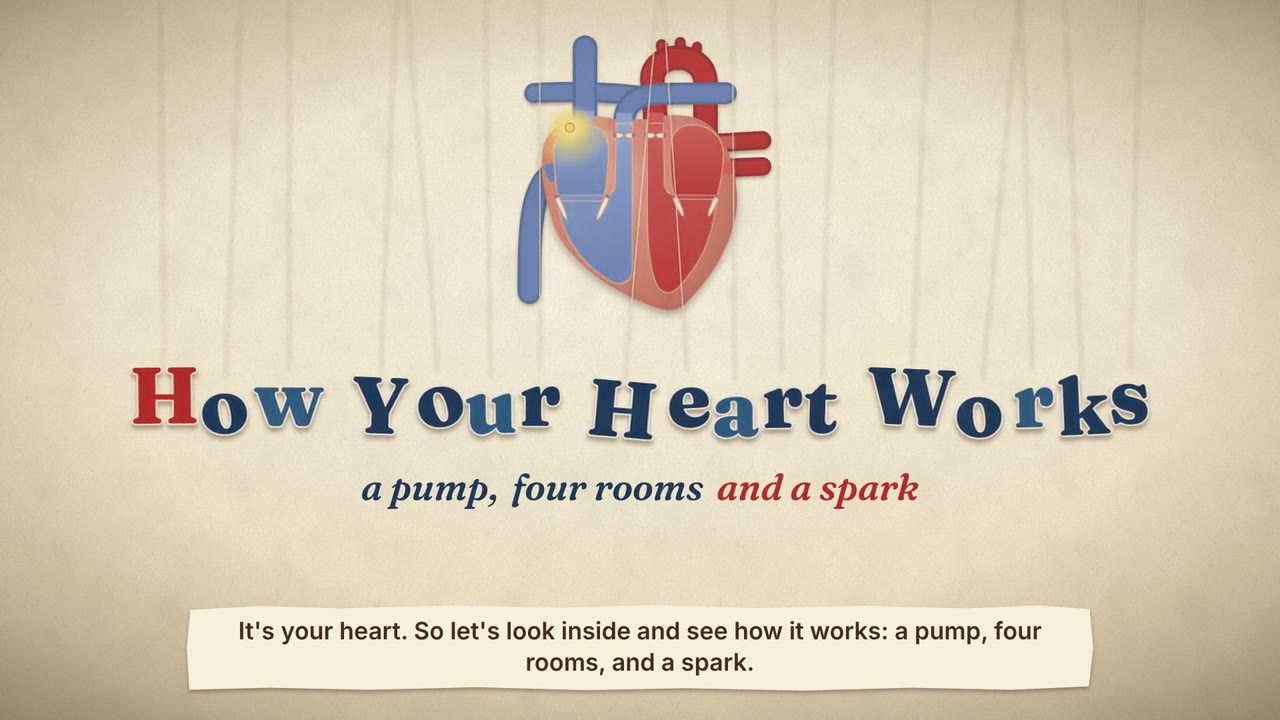
A tour of your heart: four chambers, two pumps, one-way valves that make the lub-dub, and the electrical spark behind every beat.
What happens
- Your heart is two pumps side by side: the right side sends blood to the lungs, the left side sends it to the whole body.
- Four chambers: two atria on top collect blood; two ventricles below pump it out.
- Four valves work like one-way doors. The lub-dub of your heartbeat is the sound of them closing.
- Every beat starts with an electrical spark in the SA node, your natural pacemaker, then a brief pause at the AV node, then a squeeze.
- Your heart sits near the middle of your chest, behind the breastbone, with its tip pointing left.
What you can do
- Don’t smoke or vape.
- Keep moving: aim for about 150 minutes of brisk activity a week.
- Eat mostly vegetables, fruit, whole grains, beans, nuts and fish.
- Aim for 7–9 hours of sleep a night.
- Know your numbers: blood pressure, cholesterol and blood sugar.
- See a health care provider if your heart often races, flutters or skips, or you get unusually breathless or dizzy. For sudden chest pain or pressure, call 9-1-1 or your local emergency number.
Common questions
Is my heart on the left side of my chest?
Not really. It sits near the middle of your chest, behind your breastbone, with its tip tilted to the left. That’s why you feel the beat more on the left side.
What makes the lub-dub sound of a heartbeat?
Valves closing. “Lub” is the valves between the upper and lower chambers snapping shut. “Dub” is the exit valves (aortic and pulmonary) closing a moment later.
What is a normal resting heart rate?
For most adults, 60 to 100 beats a minute at rest. It speeds up with exercise, slows during sleep, and people who exercise regularly often have a lower resting rate.
Transcript
Put a hand on your chest. That steady beat began before you were born, and it goes on about a hundred thousand times a day.
It's your heart. So let's look inside and see how it works: a pump, four rooms, and a spark.
Your heart is a muscle, about the size of your fist. Its job is to keep blood moving, so every part of you gets oxygen and fuel.
Inside are four hollow rooms, called chambers. The two on top, the atria, collect blood as it comes in. The two below, the ventricles, are the strong pumps that push blood out.
A wall of muscle, the septum, runs down the middle. So your heart is really two pumps, side by side. Seen from the front, its right side is on your left.
The right side collects blood returning from the body, low on oxygen, and pumps it on a short trip to the lungs.
In the lungs, the blood drops off carbon dioxide, the waste gas you breathe out, and picks up fresh oxygen.
That oxygen-rich blood returns to the left side. The left ventricle pumps it into the aorta, the body's largest artery, and out to every organ. It's the hardest job, so it has the thickest wall.
Then the blood returns to the right side, and the loop starts again. At rest, that's about five litres a minute, or around seven thousand litres a day.
To keep blood flowing the right way, the heart has four valves. Think of them as one-way doors.
Each valve opens to let blood through. Then its flaps snap shut, so blood can't flow backward.
Those closing valves make the sound of your heartbeat: lub-dub. Lub is the valves between the upper and lower chambers snapping shut. Dub is the exit valves, a moment later.
So what tells your heart when to beat? It doesn't wait for your brain. It has its own electrical system.
High in the right atrium is a small cluster of cells called the SA node. It's your heart's natural pacemaker. Every beat starts here, with a tiny electrical spark.
The spark spreads across both atria, and they squeeze, topping up the ventricles below.
Then the signal reaches the AV node, a checkpoint between the upper and lower chambers. It holds the signal for a split second, so the ventricles can finish filling.
Then it races down the septum and through the ventricle walls. The ventricles squeeze, pushing blood out to the lungs and body. Spark, pause, squeeze, with every beat.
At rest, most adults' hearts beat sixty to a hundred times a minute. When you exercise, nerves and hormones like adrenaline speed it up, to feed your working muscles.
When you sleep, it slows down. And with regular exercise, a stronger heart can do the same work with fewer beats.
The heart muscle needs oxygen too. It gets it from its own arteries on the outside, the coronary arteries. A blocked one causes a heart attack, which we explain in another video.
So what can go wrong? Many heart problems fit into four simple groups: valves, rhythm, pump, and supply.
A valve can become stiff and narrow, so it doesn't open fully, or leaky, so blood slips backward. The rhythm can become too fast, too slow, or irregular.
The pump can become weak or stiff. That's heart failure. It doesn't mean the heart has stopped, just that it can't keep up. And the coronary arteries can narrow with fatty plaque.
If your heart often races, flutters or skips, or you get unusually breathless or dizzy, see a health care provider. For sudden chest pain or pressure, call 9-1-1 or your local emergency number.
The good news: the same everyday habits protect every part of your heart. Don't smoke or vape, and keep moving, about a hundred and fifty minutes a week.
Eat mostly vegetables, fruit, whole grains, beans, nuts and fish. Aim for seven to nine hours of sleep. And know your numbers: blood pressure, cholesterol and blood sugar.
Now, a myth: that your heart is on the left side of your chest. It actually sits near the middle, behind your breastbone, with its tip tilted to the left. That's why you feel the beat more on that side.
So, to recap. Two pumps, with four chambers. Four one-way valves. And one tiny spark that starts every beat.
Now you know how your heart works. Look after it. It's been working for you since before you were born.
Sources
- NHLBI (NIH) — How the Heart Works
- NHLBI (NIH) — How Blood Flows through the Heart
- NHLBI (NIH) — How the Heart Beats
- American Heart Association — All About Heart Rate (Pulse)
- American Heart Association — Life’s Essential 8
- American Heart Association — What is Heart Failure?
- NHLBI (NIH) — Heart Valve Diseases
- Cleveland Clinic — Heart: Anatomy & Function
General information, not medical advice. If you think you or someone else is having a medical emergency, call 9-1-1 or your local emergency number.