Heart Failure, Explained
when the pump can't keep up
Heart health · animated video, 4:27 · updated September 28, 2026
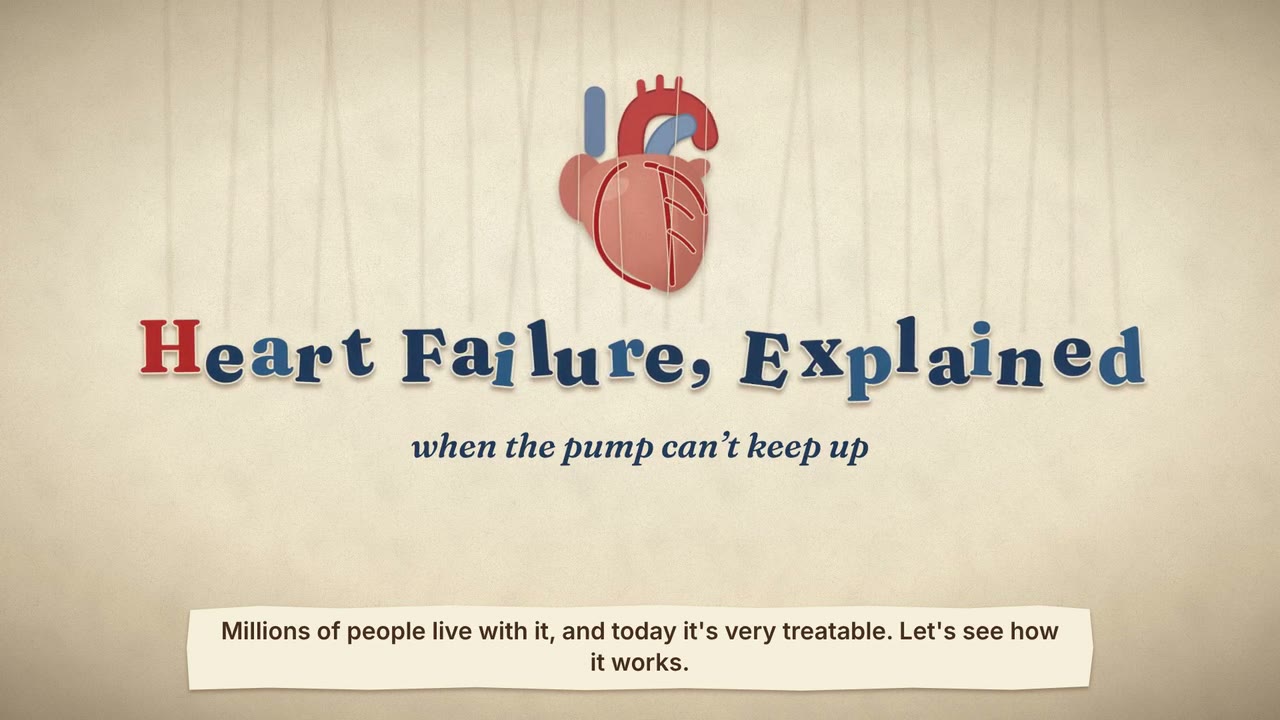
Heart failure doesn't mean the heart has stopped. Learn why the pump can't keep up, the signs of fluid build-up, and the treatment and daily care that help.
What happens
- Heart failure means the heart can't pump or fill well enough to meet the body's needs. It does not mean the heart has stopped.
- There are two main types: a weak pump (reduced ejection fraction) and a stiff pump (preserved ejection fraction). About half of people with heart failure have the stiff kind.
- When the pump can't keep up, the kidneys hold on to salt and water. That extra fluid causes breathlessness, swollen feet, ankles and legs, and quick weight gain.
- An echocardiogram (heart ultrasound) and a BNP blood test are the key tests.
- Today's medicines help people with a weak pump live longer, stay out of hospital and feel better, and daily self-care keeps you on track.
Know the warning signs
- Shortness of breath when active, or when lying flat
- Needing extra pillows, or waking at night short of breath
- Swollen feet, ankles or legs
- Quick weight gain over a day or a few days
- Tiredness and weakness
If your breathing, swelling or weight is getting worse, call your care team soon. For severe trouble breathing, chest pain or fainting, call 9-1-1 or your local emergency number right away.
Call 9-1-1 or your local emergency number.
What you can do
- Weigh yourself every morning, after using the toilet and before breakfast, and write it down. Ask your care team how much gain should prompt a call.
- Take your medicines every day, even when you feel well, and keep your follow-up visits.
- Follow your care team's advice on salt and fluids.
- Stay active. Ask about a cardiac rehab program to build strength safely.
- Keep up with vaccines, like the yearly flu shot.
- Know the warning signs and when to call for help.
Common questions
Does heart failure mean my heart is going to stop?
No. Heart failure means the heart can't pump or fill well enough to keep up with what the body needs. It keeps beating. It is a long-term condition, and with treatment many people live full, active lives.
What is ejection fraction?
It's the share of blood the main pumping chamber pushes out with each squeeze. A healthy heart pushes out about half or more (roughly 50–70%). In heart failure with reduced ejection fraction it is 40% or less; in heart failure with preserved ejection fraction it is normal, but the muscle is stiff and doesn't fill well.
Should I rest and avoid exercise if I have heart failure?
For most people, no. Regular activity helps people with heart failure feel stronger and do more. A cardiac rehab program can help you start safely. Ask your care team what's right for you.
Transcript
Heart failure. It's a frightening name. It sounds as if the heart has stopped, or is about to. But that's not what it means at all.
Heart failure means the heart can't pump or fill well enough to keep up with what the body needs. Millions of people live with it, and today it's very treatable. Let's see how it works.
A healthy heart is a muscular pump. Its main pumping chamber, the left ventricle, sends oxygen-rich blood out to your whole body with every beat.
Each beat has two steps. First, the muscle relaxes, and the chamber fills with blood. Then it squeezes, and pushes blood out.
In one kind of heart failure, the muscle is weak and stretched. It can't squeeze hard enough, so less blood goes out with each beat.
Doctors measure this with the ejection fraction: the share of blood pushed out with each squeeze. A healthy heart pushes out about half or more. A weak pump pushes out much less. That's called reduced ejection fraction.
In the other kind, the pump squeezes normally, but the muscle is stiff. It can't relax and fill properly, so each beat has less blood to send.
This is called preserved ejection fraction, and about half of all people with heart failure have this type.
When the pump can't keep up, not enough blood reaches the body. The kidneys sense the shortfall, and hold on to salt and water, trying to help.
But the extra fluid has to go somewhere. It backs up into the lungs, and it seeps into the tissues, often in the feet, ankles and legs.
So the common signs include getting out of breath when you're active, or when you lie flat. Some people need extra pillows, or wake up at night short of breath.
There may also be swollen feet, ankles or legs, tiredness, and a quick gain in weight over a few days. That's fluid, not fat.
If your breathing, swelling or weight is getting worse, call your care team soon. But for severe trouble breathing, chest pain, or fainting, call 9-1-1 or your local emergency number right away.
What causes heart failure? Usually, something has damaged or overworked the heart over time. The most common causes are coronary artery disease, including past heart attacks, and high blood pressure.
Others include heart valve problems, diabetes, some irregular heart rhythms, heavy drinking, and diseases of the heart muscle itself.
To find out, a health care provider will examine you and usually order two key tests. An echocardiogram, an ultrasound of the heart, shows how well it squeezes and fills.
And a blood test called BNP measures a hormone the heart releases when it's under strain.
Now the good news. Today's treatments really work. For heart failure with a weak pump, a combination of medicines can help people live longer, stay out of hospital, and feel better.
Some ease the strain on the heart. Some block stress hormones. And water pills help clear extra fluid. There are helpful treatments for the stiff type, too.
What you do each day matters too. Weigh yourself every morning, after using the toilet and before breakfast, and write it down.
A quick gain over a day or a few days can be an early warning of fluid building up, sometimes before you feel it. Ask your care team how much gain should prompt a call.
Take your medicines every day, even when you feel well. Follow your team's advice on salt and fluids. And keep up with vaccines, like the flu shot, since infections can strain the heart.
One common myth is that heart failure means you should rest and avoid activity. In fact, regular activity helps most people. A cardiac rehab program can help you build strength, safely.
So, to recap. Heart failure means the pump can't keep up. Fluid builds up and causes the symptoms. Treatment really helps. And daily habits keep you on track.
Now you know what heart failure is, and how it's treated. With good care, many people with heart failure live full, active lives.
Sources
- 2022 AHA/ACC/HFSA Guideline for the Management of Heart Failure (Circulation)
- Canadian Cardiovascular Society — 2017 Comprehensive Update of the CCS Heart Failure Guidelines (Can J Cardiol)
- CCS/CHFS 2025 Guideline: Heart Failure With Nonreduced Ejection Fraction
- Heart & Stroke Foundation of Canada — Heart failure
- American Heart Association — What is Heart Failure?
- American Heart Association — Heart Failure Signs and Symptoms
- American Heart Association — Ejection Fraction Heart Failure Measurement
- NHLBI (NIH) — Heart Failure
General information, not medical advice. If you think you or someone else is having a medical emergency, call 9-1-1 or your local emergency number.