Choking
how to help an adult who can't breathe
Emergencies · animated video, 4:41 · updated September 28, 2026
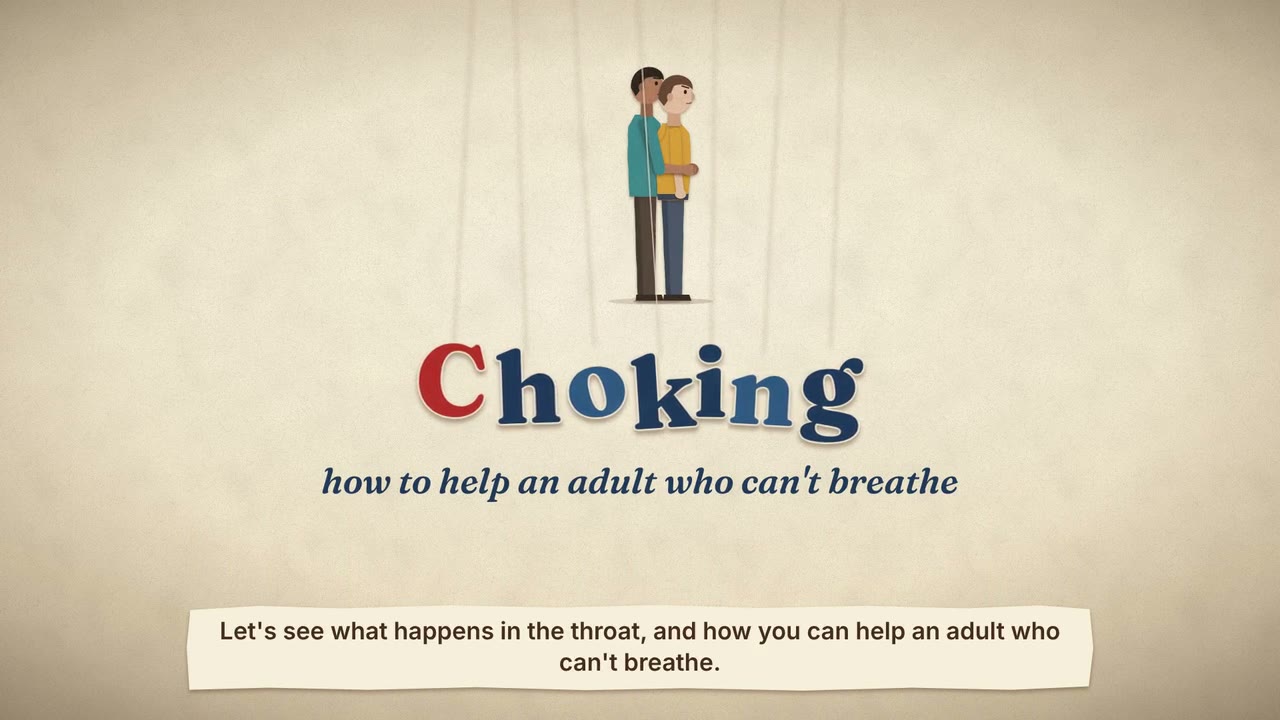
If an adult can't speak, cough or breathe, call 9-1-1 and give 5 back blows, then 5 abdominal thrusts. Here's how choking happens and how to help.
What happens
- The windpipe (air) and the food pipe (food) start side by side in the throat. When you swallow, a flap called the epiglottis covers the windpipe.
- Mild choking: the person can cough or speak. Encourage them to keep coughing, don't interfere, and stay with them.
- Severe choking: they can't speak, cough or breathe, and may clutch their throat. Have someone call 9-1-1 and act right away.
- Give 5 firm back blows between the shoulder blades, then 5 quick abdominal thrusts just above the belly button, and keep alternating.
- If they become unresponsive, lower them to the ground and start CPR. After severe choking, they should be checked in hospital even if they seem fine.
Know the warning signs
- Can't speak, cough or breathe
- High-pitched squeaking sounds, or no sound at all
- Hands clutching the throat (the universal sign for choking)
- A look of panic; skin turning flushed, then pale or bluish
If an adult can't speak, cough or breathe, have someone call 9-1-1 or your local emergency number and start back blows and abdominal thrusts right away.
Call 9-1-1 or your local emergency number.
What you can do
- Take small bites, chew well and eat slowly.
- Try not to talk, laugh or walk around with food in your mouth.
- Get loose or poorly fitting dentures checked.
- Take a first-aid course: it covers choking in adults, children and babies, and lets you practise.
- If you choke when you're alone, call 9-1-1, leave the line open, and thrust your upper belly against the back of a chair.
Common questions
Should I give back blows or the Heimlich manoeuvre (abdominal thrusts)?
Both. For an adult with severe choking, the Canadian Red Cross and the Heart & Stroke Foundation teach 5 firm back blows between the shoulder blades, then 5 abdominal thrusts, repeated until the object comes out, the person can breathe or cough, or they become unresponsive. The 2025 American Heart Association guidelines now recommend the same order. Some courses teach a slightly different combination; what matters most is to act fast.
What if the person is pregnant or I can't reach around them?
Use chest thrusts instead of abdominal thrusts. Stand behind them, put your fist in the middle of their chest with your other hand over it, and pull straight back, alternating with 5 back blows. If they become unresponsive, lower them to the ground, call 9-1-1 and start CPR.
Do they need to see a doctor after choking?
Yes, after severe choking. The object, and the back blows and thrusts themselves, can injure the throat or organs inside, so the Canadian Red Cross advises calling 9-1-1 and having the person checked in hospital even if they seem fine. After mild choking, get medical help if they have any trouble breathing afterwards.
Transcript
You're at dinner with family. Someone takes a bite, and suddenly goes quiet. They can't speak. Their hands go to their throat.
They're choking, and every second counts. Let's see what happens in the throat, and how you can help an adult who can't breathe.
At the back of your throat, two tubes sit side by side. The windpipe, in front, carries air to your lungs. The food pipe, behind it, carries food to your stomach.
Each time you swallow, a small flap called the epiglottis folds down over the windpipe, like a lid, so food slides safely into the food pipe.
But if you talk or laugh while chewing, or swallow a piece that's too big, food can slip the wrong way and get stuck in the airway.
Your body's first defence is a cough: a strong burst of air from the lungs that tries to push the food back out.
So the first question is: can they cough, or speak? If they can, air is still getting through. That's mild choking.
Encourage them to keep coughing hard, and help them sit upright if you can. Stay with them, and watch closely in case it gets worse.
Severe choking looks different. They can't speak, cough or breathe. There may be a high-pitched squeak, or no sound at all. Often, they clutch their throat. That's the universal sign for choking.
Now the airway is blocked, and no air can reach the lungs. This is life-threatening, so act right away.
Ask: are you choking? If they nod, tell them you'll help. Shout for someone to call 9-1-1 or your local emergency number, and start right away.
Start with back blows. Stand slightly behind them, and put one arm across their chest for support. Then lean them forward at the waist.
With the heel of your other hand, give up to five firm blows between the shoulder blades.
If the object doesn't come out, switch to abdominal thrusts. Stand behind them, and wrap your arms around their waist.
Make a fist, and place it just above the belly button, well below the ribs. Cover your fist with your other hand.
Then pull sharply inward and upward, up to five times. Each thrust pushes air up from the lungs, like a forced cough.
Keep switching: five back blows, then five abdominal thrusts, until the object comes out, the person can breathe or cough, or they become unresponsive.
This is the sequence taught today by the Canadian Red Cross and the Heart and Stroke Foundation. Your first-aid course may teach a slightly different order. What matters most is to act fast.
If the person is pregnant, or too large for your arms to reach around, use chest thrusts instead of abdominal thrusts: your fist goes in the middle of the chest, and you pull straight back.
If you're alone and choking, call 9-1-1 and leave the line open, even if you can't talk. Then thrust your belly hard against the back of a chair, or the edge of a table.
If the person becomes unresponsive, lower them gently to the ground. Make sure 9-1-1 has been called, and start CPR, beginning with chest compressions.
If you're trained to give breaths, look in the mouth before each set of breaths, and remove the object only if you can see it. If not, keep pushing hard and fast on the chest.
Once the object is out, they still need to be checked in hospital. The choking, and the blows and thrusts, can injure the throat or organs inside. So call 9-1-1 even if they seem fine.
To lower the risk, take small bites, chew well, and eat slowly. Try not to talk or laugh with food in your mouth. And get loose dentures checked.
One common myth: if someone is coughing on food, slap them hard on the back. But while they can cough strongly, their own cough is the best tool. Don't interfere. Stay close, ready to help.
So, to recap. Can they cough? Let them cough. Can't speak, cough or breathe? Call 9-1-1, then give five back blows and five abdominal thrusts. If they become unresponsive, start CPR.
Now you know how to help an adult who is choking. Babies need a different technique, so consider a first-aid course. A few calm, quick steps can save a life.
Sources
- Canadian Red Cross: Comprehensive Guide for First Aid & CPR (2025), Choking
- Canadian Red Cross: Helping a Choking Adult (poster)
- Heart & Stroke Foundation of Canada: Highlights of the 2025 Guidelines for CPR and ECC
- American Heart Association: Updated CPR guidelines tackle choking response (2025)
- Part 7: Adult Basic Life Support, 2025 AHA Guidelines (Circulation)
- ILCOR 2025 Consensus on Science: Executive Summary (Circulation)
- The Conversation: What to do if someone's choking — evidence says begin with back blows
General information, not medical advice. If you think you or someone else is having a medical emergency, call 9-1-1 or your local emergency number.